


Why Your AC Is Blowing Warm Air (And How to Fix It Fast)
AC blowing warm air troubleshooting starts with a few quick checks you can do right now, before calling anyone.
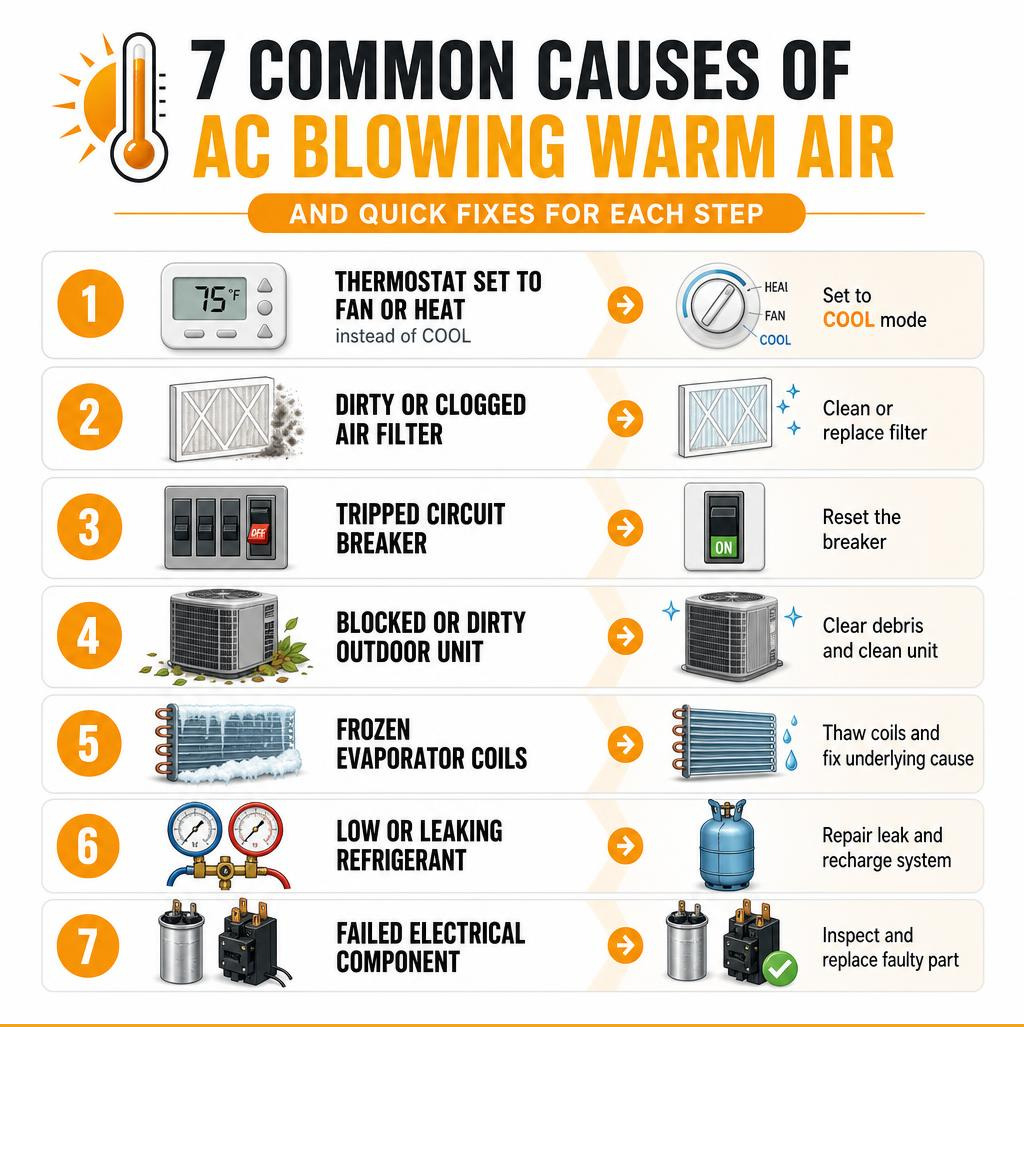
Quick answer – here are the most common causes:
- Thermostat set to FAN or HEAT instead of COOL – check this first
- Dirty or clogged air filter – responsible for about 40% of all AC service calls
- Tripped circuit breaker – cuts power to the outdoor unit while the indoor fan keeps running
- Blocked or dirty outdoor condenser unit – prevents heat from escaping outside
- Frozen evaporator coils – ice buildup stops the cooling process entirely
- Low or leaking refrigerant – requires a certified technician to repair
- Failed electrical component – such as a capacitor or compressor
About 70% of warm air problems come down to just three of these: thermostat settings, a dirty filter, or an issue with the outdoor unit. Start there, and you will solve most problems without a service call.
There is nothing worse than walking into your home on a hot Central Texas afternoon and feeling warm air blowing from your vents. Your AC is running, the fan is going, but the house just keeps getting hotter. It is frustrating, and in Texas summers, it can become uncomfortable fast.
The good news is that most causes of an AC blowing warm air are fixable. Some you can handle yourself in under 10 minutes. Others need a trained technician. This guide walks you through all seven steps in plain language so you know exactly what to check and what to do next.
I’m Chris Woods, owner of Woods Comfort Systems, a third-generation HVAC company serving Central Texas since 1956. Over the decades, our team has diagnosed and repaired hundreds of AC blowing warm air troubleshooting cases, and the patterns are remarkably consistent. In the steps below, I’ll share exactly what our technicians check first so you can use the same approach at home.
Step 1: Verify Your Thermostat Settings
It sounds simple, but a surprising number of service calls in San Marcos, TX and Austin, TX end up being simple thermostat mistakes. Before worrying about major mechanical failures, take a close look at your wall controller.
Check the Operating Mode
Ensure your thermostat is actually set to COOL. During seasonal transitions in Central Texas, it is easy to switch the system to HEAT on a cool night and forget to change it back when afternoon temperatures rise.
Understand FAN ON vs. FAN AUTO
If your thermostat is set to COOL but the fan setting is set to ON instead of AUTO, your indoor blower will run continuously. When the cooling cycle ends, the outdoor unit shuts down, but the indoor fan keeps blowing. This circulates uncooled, room-temperature, or humid air through your vents, making it feel like the system is malfunctioning. Switching the setting to AUTO ensures the fan only blows when the system is actively cooling the air.
For more details on how minor settings can impact your comfort, you can read about why is my AC blowing hot air? Troubleshooting tips. If your thermostat is configured correctly but the air remains warm, you may need to learn how to fix AC unit not cooling in 5 simple steps to rule out other basic control issues.
Step 2: Inspect and Replace the Air Filter
A dirty air filter is the number one cause of AC cooling problems, accounting for roughly 40% of all HVAC service calls. When a filter becomes heavily clogged with dust, pet hair, and Texas pollen, it severely restricts airflow.
The Impact of Restricted Airflow
Your AC needs a steady stream of warm return air passing over the indoor evaporator coils to absorb heat. When airflow is blocked:
- The system cannot cool your home efficiently.
- The evaporator coils can drop below freezing, causing condensation to freeze solid.
- The system works twice as hard, driving up your monthly energy bills.
To check your filter, pull it out of the return duct or air handler and hold it up to a light source. If you cannot see light passing through the fibers, it is time for a replacement. Keeping a clean filter in place is essential to understand why your AC system is not cooling your home and to prevent unnecessary strain on your compressor.
Step 3: Check the Outdoor Condenser Unit
Your air conditioner does not actually “create” cold air. Instead, it absorbs heat from inside your home and transfers it outdoors. The outdoor condenser unit is responsible for releasing that heat. If the condenser is dirty, blocked, or covered in debris, the heat remains trapped inside your system.
Clear the Area Around the Unit
In communities like Wimberley, TX and Kyle, TX, landscaping can quickly grow around the outdoor unit. Maintain at least a two-foot clearance around the condenser. Remove any:
- Tall grass and weeds
- Fallen leaves and twigs
- Overhanging shrubbery or vines
Clean the Condenser Coils
Over time, dirt, dust, and grass clippings from lawnmowing build up on the delicate metal fins of the outdoor unit. This dirt acts as an insulating blanket, keeping the heat trapped. Turn off power to the unit at the outdoor disconnect box, and gently spray the exterior coils with a garden hose using a soft spray pattern. Never use a high-pressure washer, as this can easily bend the aluminum fins and permanently restrict airflow.
If you live in South Central Texas, keeping this unit clean is one of the most important steps to address the common reasons your AC is not cooling in San Marcos, TX.
Step 4: Examine the Circuit Breakers and Power Switches
It is common for an AC system to appear to run while blowing warm air because the indoor blower fan and the outdoor condenser unit run on separate electrical circuits. If the breaker for the outdoor unit trips, the indoor fan will continue to blow warm, uncooled air throughout your home.
Check the Electrical Panel
Locate your main electrical panel and check for any tripped circuit breakers. Look specifically for switches labeled AC, Condenser, or Compressor. A tripped breaker will sit in the middle position between ON and OFF. To reset it:
- Flip the switch completely to the OFF position.
- Flip it back to the ON position.
Check the Outdoor Disconnect Box
There is also a physical power switch or pullout fuse box located on the exterior wall near your outdoor unit. Ensure this switch is turned ON.
If the breaker trips again immediately after you reset it, do not try to reset it a second time. This indicates a serious electrical fault or a failing compressor. For safety reasons, you should consult professional resources like the diagnostic checklists found at air conditioner blows warm air to understand the underlying electrical hazards.
Step 5: Look for Frozen Evaporator Coils
When airflow is restricted or refrigerant is low, the temperature of your indoor evaporator coils can plunge below 32 degrees Fahrenheit. This causes the moisture extracted from your indoor air to freeze on the coils, block airflow, and stop the cooling process entirely.
How to Identify Frozen Coils
You can check for frozen coils by looking at the indoor air handler or the copper refrigerant lines running to the outdoor unit. Signs of frozen coils include:
- Visible ice buildup on the copper lines.
- Frost or ice forming on the exterior of the air handler cabinet.
- A damp, musty smell coming from your vents.
- Water pooling around the indoor unit as the ice melts.
If you suspect your system is frozen, turn it off immediately at the thermostat. Running an AC with frozen coils can cause severe liquid slugging in the compressor, which can destroy the unit. Switch the thermostat to OFF and set the fan mode to ON to help circulate warm air and thaw the ice. For a complete walkthrough on how to handle this issue safely, check out our guide on troubleshooting frozen AC coils.
Step 6: Identify Potential Refrigerant Leaks
Refrigerant is the vital chemical fluid that absorbs heat from your indoor air and carries it outside. Unlike fuel in a car, an AC does not consume refrigerant. The chemical circulates in a closed loop. If your system is low on refrigerant, it means you have a leak.
Signs of a Refrigerant Leak
A system running low on refrigerant cannot absorb heat effectively, resulting in lukewarm air coming from your vents. Watch for these common signs of a leak:
- Lukewarm air blowing continuously.
- A persistent hissing or bubbling sound coming from the indoor or outdoor unit.
- Ice forming on the refrigerant lines or evaporator coils.
- Unusually high electricity bills as the system runs constantly without cooling.
Because refrigerant is a regulated substance, finding and repairing leaks requires specialized tools and EPA certification. If you suspect a leak, do not ignore it. You can learn more about how this impacts your home by reading our article don’t sweat it if your air conditioning unit is not cooling your house.
Step 7: Electrical and Mechanical Component Failures
If you have completed the basic checks and your AC is still blowing warm air, the problem may lie in a failed mechanical or electrical component inside the outdoor unit.
Common Component Culprits
- Failed Capacitor: The capacitor acts like a large battery that provides the initial electrical boost to start the compressor and outdoor fan. If it fails, the fan or compressor will not run, preventing heat transfer.
- Bad Contactor: The contactor is an electrical switch that controls power to the compressor and fan. If the contactor contacts burn out, the outdoor unit will not turn on.
- Compressor Failure: Often called the heart of the AC system, the compressor pumps the refrigerant through the lines. If the compressor fails, the cooling cycle stops completely.
| Issue | Can I Fix It DIY? | Professional Required? | Why? |
|---|---|---|---|
| Thermostat Settings | Yes | No | Simple setting adjustment on the wall controller. |
| Dirty Air Filter | Yes | No | Easy slide-in replacement requiring no tools. |
| Blocked Condenser | Yes | No | Gentle cleaning with a garden hose and clearing brush. |
| Tripped Breaker | Yes (Once) | Yes (If persistent) | A single reset is safe; repeated trips indicate an electrical short. |
| Frozen Coils | No | Yes | Requires diagnosing the underlying airflow or refrigerant issue. |
| Refrigerant Leak | No | Yes | Requires EPA certification to handle and recharge chemicals. |
| Failing Capacitor | No | Yes | High voltage poses severe shock hazards. |
If you suspect a failed electrical component, it is best to leave the repair to the experts. You can explore our professional AC repair services to get your system diagnosed safely and accurately.
Advanced AC Blowing Warm Air Troubleshooting
For homeowners who want to dig deeper, advanced troubleshooting requires understanding how your system handles heat transfer and electrical signals.
When our technicians arrive at a home in New Braunfels, TX or Buda, TX, they use specialized diagnostic tools to measure the temperature differential across the evaporator coil. A healthy system should have a temperature drop of 15 to 20 degrees Fahrenheit between the return air and the supply air vents. If this drop is minimal, it indicates a bottleneck in the heat transfer process.
We also check the electrical draw of the compressor. A compressor drawing too many amps may be overheating and shutting down on thermal overload. This causes the system to cycle on and off rapidly, leading to periods where the indoor fan blows uncooled air.
When to Call a Professional for AC Blowing Warm Air Troubleshooting
While we encourage homeowners to handle simple tasks like replacing filters and clearing debris, there are clear boundaries where DIY troubleshooting should stop. You should call a professional technician if:
- You suspect a refrigerant leak: Handling refrigerant requires specialized recovery equipment to prevent environmental damage.
- The circuit breaker keeps tripping: This is a clear sign of a short circuit or an overloaded electrical component that poses a fire hazard.
- You hear unusual noises: Squealing, grinding, or loud chattering noises from the outdoor unit indicate a failing fan motor or compressor.
- Your system has electrical issues: High-voltage capacitors carry enough stored energy to cause severe electrical shock, even when the power is turned off.
Preventive Maintenance to Avoid AC Blowing Warm Air Troubleshooting Issues
The best way to handle an AC blowing warm air is to prevent the problem from occurring in the first place. Regular maintenance keeps your system running efficiently and extends its overall lifespan.
- Change filters regularly: Replace your air filters every 30 to 90 days, depending on whether you have pets or allergies.
- Schedule annual tune-ups: Having a professional technician inspect your system every spring ensures minor issues like weak capacitors or small refrigerant leaks are caught before they turn into major summer breakdowns.
- Keep the outdoor unit clear: Regularly check your outdoor unit to ensure leaves, dirt, and weeds are not blocking airflow.
Frequently Asked Questions About AC Cooling Issues
Why is my AC running but blowing warm air?
This is typically caused by incorrect thermostat settings, a dirty air filter blocking airflow, or a tripped circuit breaker cutting power to the outdoor condenser unit while the indoor fan continues to run.
How long does it take for frozen AC coils to thaw?
It generally takes between 12 and 24 hours for frozen evaporator coils to thaw completely. You should keep the AC system turned off during this time and run the indoor fan in ON mode to speed up the process.
Can a dirty air filter cause an AC to blow warm air?
Yes. A heavily clogged air filter restricts airflow over the indoor evaporator coils, which can cause the coils to freeze and stop the cooling process entirely, resulting in warm air blowing from your vents.
How do I know if my AC has a refrigerant leak?
Common signs include lukewarm air from the vents, ice buildup on the copper refrigerant lines, a hissing or bubbling sound from the unit, and a sudden, unexplained spike in your monthly utility bills.
Why is my outdoor AC unit running but the indoor fan is blowing warm air?
If the outdoor unit is running but you only feel warm air inside, the issue could be a failed compressor, frozen indoor coils, or a complete loss of refrigerant due to a leak.
What does it mean if my AC blows cold air then warm air?
This is often a sign of short cycling. The system may be shutting down prematurely due to an overheating compressor, a faulty thermostat, or a safety switch triggering due to a clogged condensate drain line.
Is it safe to run my AC if it is blowing warm air?
No. If your AC is blowing warm air, running it continuously can cause severe damage to the compressor, leading to expensive repairs or requiring a complete system replacement.
How much does it cost to fix an AC blowing warm air in San Marcos, TX?
The cost can vary significantly depending on the cause. Simple issues like replacing a thermostat battery or cleaning a filter are very inexpensive, while replacing a compressor or repairing a major refrigerant leak can be a significant investment.
Can a tripped circuit breaker cause my AC to blow warm air?
Yes. Because the indoor blower fan and the outdoor condenser unit run on separate breakers, a tripped outdoor breaker will cut power to the cooling components while the indoor fan continues to circulate warm air.
How often should I schedule professional AC maintenance?
We recommend scheduling professional maintenance at least once a year, ideally in the spring before the hot summer weather arrives in Central Texas.
Conclusion
When your air conditioner starts blowing warm air, a systematic approach to troubleshooting can help you identify simple fixes before you need to call for service. By checking your thermostat, replacing your air filter, and keeping your outdoor unit clean, you can resolve many common issues yourself.
Whether you need fast AC repairs, seasonal HVAC maintenance, or a complete system replacement, the team at Woods Comfort Systems is ready to help. Schedule AC repair today to restore reliable comfort to your Central Texas home.