


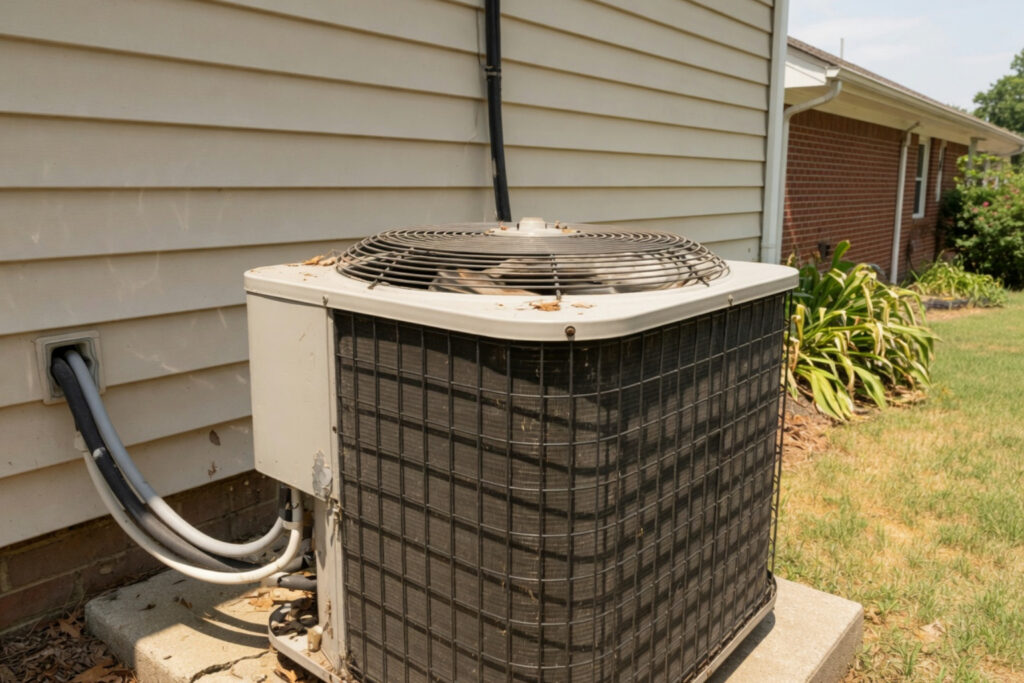
Why Your AC Unit Is Not Cooling (And What to Do Right Now)
If your AC unit is not cooling your home, here are the most common reasons and what you can check immediately:
Quick Answer: Most Likely Causes
- Thermostat set incorrectly: Check that it’s set to COOL mode and at least 3-5 degrees below room temperature
- Dirty or clogged air filter: A blocked filter is the single most common cause of AC cooling failure
- Frozen evaporator coil: Ice buildup blocks heat transfer and stops cold air from reaching your rooms
- Blocked outdoor condenser unit: Debris around the unit prevents heat from escaping outside
- Low refrigerant from a leak: Requires a licensed HVAC technician to diagnose and repair
- Tripped circuit breaker: A quick reset may restore normal operation
- Electrical component failure: Capacitor or compressor issues need professional attention
There is a particular kind of frustration that comes with an AC running on a hot summer afternoon while the house just refuses to cool down. The system is humming, air is moving through the vents, but an hour later you are still sweating. For Central Texas homeowners, where summer temperatures regularly push well past 90 degrees, a cooling failure is not just uncomfortable; it can become a genuine health concern fast.
The good news is that many of the most common causes of an AC unit not cooling are things you can check and sometimes fix yourself in under 10 minutes. According to service data from HVAC professionals, simple homeowner checks resolve roughly 12-15% of AC cooling calls before a technician ever needs to show up. That means a significant number of homeowners are calling for service when the fix is as straightforward as a dirty filter or a thermostat set to the wrong mode.
That said, other causes, like refrigerant leaks, frozen evaporator coils, or a failing capacitor, do require professional diagnosis and repair. Knowing the difference between what you can handle and when to call for help can save you time, money, and potential damage to your system.
I’m Chris Woods, owner of Woods Comfort Systems, a third-generation HVAC company serving Central Texas since 1956, and over the decades our team has diagnosed and repaired thousands of AC unit not cooling calls across San Antonio, TX, Austin, TX, and the surrounding communities. In this guide, I’ll walk you through a straightforward five-step troubleshooting process so you can confidently identify what is wrong and know exactly when it is time to bring in a pro.
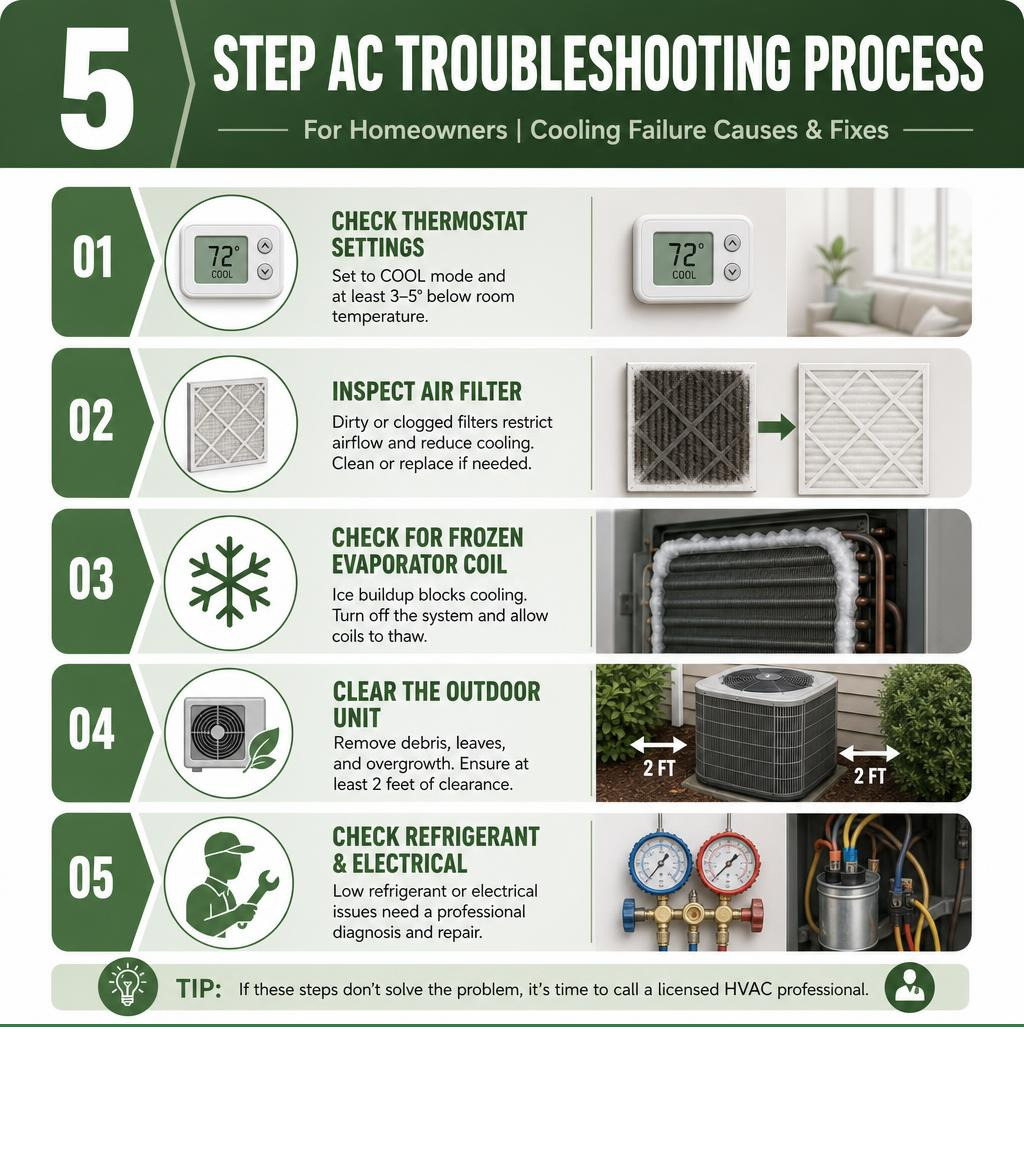
Common Reasons Your AC Unit Not Cooling
When your central air conditioning system is running but failing to lower the indoor temperature, it means something has broken the cooling chain. Your AC does not actually create cold air; rather, it absorbs heat from inside your home and dumps it outside. Anything that blocks this heat exchange process will cause your system to blow lukewarm air.
Let’s look at the most common culprits behind a failing AC system, ranked by how often our technicians encounter them during hot Texas summers:
- Airflow Restriction: If air cannot flow freely across your indoor evaporator coil, the system cannot absorb heat from your home. This leads to weak airflow, lukewarm vents, and eventually a completely frozen system. When the AC unit is not cooling due to restricted airflow, the blower motor has to work twice as hard, which can lead to premature motor failure.
- Capacitor Failure: The capacitor acts like a heavy-duty battery that gives your outdoor compressor and fan motor the electrical push they need to start running. Capacitor failure accounts for 25% to 30% of summer emergency AC service calls, especially during intense heat waves when systems run continuously.
- Refrigerant Leaks: Refrigerant is the chemical lifeblood of your AC, cycling between liquid and gas states to move heat. Despite what some believe, refrigerant is not consumed like fuel. If your system is low, you have a leak. Refrigerant leaks represent 15% to 20% of AC not cooling service calls.
- Frozen Evaporator Coils: When airflow is restricted or refrigerant is low, the temperature of the indoor coil drops below freezing. Moisture from your indoor air condenses on the coil and quickly turns to ice, blocking all heat transfer. Frozen evaporator coils account for 10% to 15% of emergency service calls.
If you are currently dealing with a system that is struggling to keep up, reading our complete breakdown on why your air conditioner is not cooling your house will help you understand the core mechanics of how these components interact.
5 Simple Steps to Fix Your AC Unit
Before you pick up the phone to schedule an emergency service visit, we recommend walking through this five-step troubleshooting checklist. These simple, safe checks can resolve many common cooling issues and potentially save you the cost of a professional diagnostic fee.
Step 1: Check and Adjust Thermostat Settings
It sounds incredibly simple, but you would be surprised how many service calls end with our technician simply flipping a switch on the thermostat. Thermostats can easily be bumped, reset during a power surge, or set incorrectly by a well-meaning family member.
First, confirm that your thermostat is set to COOL and not HEAT or FAN. If the thermostat is set to FAN ON, the indoor blower motor will run continuously even when the outdoor unit is turned off. This circulates unconditioned air throughout your home, making the air coming from your vents feel warm and humid. Switching the setting to AUTO ensures the blower only runs when the system is actively cooling.
Next, check the temperature setting. The setpoint should be at least 3 to 5 degrees below the current indoor temperature to trigger the system to turn on. If your thermostat screen is completely blank or dim, replace the batteries immediately.
Additionally, keep in mind that thermostat placement matters. If your thermostat is installed in direct sunlight or near a heat source like a kitchen appliance, it will read an artificially high temperature. This can cause your system to run constantly or cycle incorrectly, a common issue we see when an AC system making home hotter in Woodcreek, TX is reported by frustrated homeowners.
Step 2: Replace a Clogged Air Filter
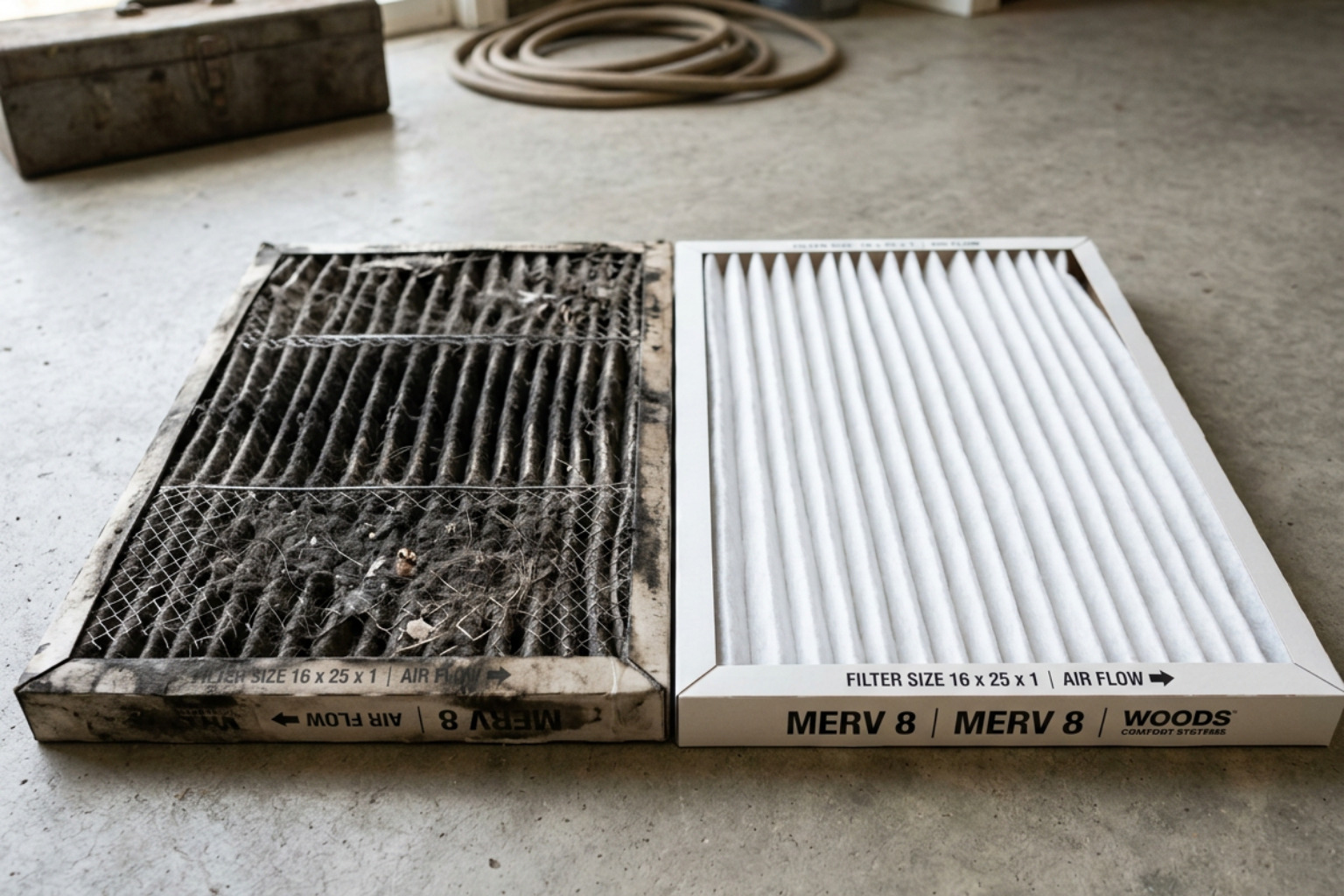
A dirty air filter is the most frequent reason an air conditioner stops cooling. When an air filter becomes heavily loaded with dust, pet dander, and debris, it acts like a wall, restricting the volume of air passing through your system.
This restriction causes a dramatic rise in static pressure, putting immense strain on your blower motor. Without enough warm indoor air passing over the cold evaporator coil to keep it warm, the coil temperature drops below freezing, causing the condensation on it to freeze solid. Once the coil is encased in ice, your AC can no longer absorb heat, and it will blow lukewarm air.
Locate your filter return grille or the filter slot next to your indoor air handler. Slide the filter out and hold it up to a light source. If you cannot see light passing through the fibers, it is completely clogged and must be replaced. For more details on how restricted airflow impacts systems in our local area, check out the common reasons your AC is not cooling in San Marcos, TX.
Step 3: Clear and Clean the Outdoor Condenser Unit
Your outdoor unit is responsible for releasing the heat absorbed from inside your home. If the metal fins on the outdoor condenser are caked in mud, grass clippings, leaves, or pollen, the heat becomes trapped, forcing the compressor to work much harder until it eventually overheats and shuts down.

To safely clean your outdoor unit, follow these steps:
- Turn off the power to your AC at the thermostat and at the outdoor disconnect switch (usually located in a small metal box mounted on the wall near the unit).
- Clear away any weeds, bushes, or tall grass within a 2-foot radius of the unit to ensure proper airflow.
- Gently use a vacuum brush attachment to remove loose leaves and cobwebs from the exterior fins.
- Using a standard garden hose with a gentle spray nozzle, rinse the condenser coils from the top down.
Safety Warning: Never use a pressure washer to clean your AC coils. The intense pressure will easily bend the delicate aluminum fins, permanently restricting airflow and causing severe system damage.
Step 4: Inspect Vents and Clear Obstructions
For your AC to cool your home evenly, air must circulate freely through a balanced loop of supply registers (which blow cold air in) and return grilles (which pull warm air out). If this balance is disrupted, your system will struggle.
Walk through every room in your home and make sure all supply vents are fully open. Many homeowners close vents in unused rooms to try to save energy, but this is a mistake. Modern central AC systems are designed to move a specific volume of air. Closing vents increases the static pressure inside your ductwork, which reduces airflow, strains the blower motor, and can cause the evaporator coil to freeze up.
Additionally, verify that large furniture, area rugs, or heavy drapes are not blocking your return grilles. A blocked return grille starves your system of air, leading to the exact same cooling failures as a dirty air filter.
Step 5: Reset the AC Circuit Breaker
Sometimes, a minor electrical surge or an unusually hot afternoon can cause your AC to draw too much power, tripping the circuit breaker to prevent electrical damage.
Go to your home’s main electrical panel and locate the breakers labeled for your AC (usually labeled “AC Condenser” for the outdoor unit and “Furnace” or “Air Handler” for the indoor unit). Even if a breaker does not look like it has tripped, it may be sitting in a halfway position.
To perform a proper hard reset, flip the breaker completely to the OFF position, wait 60 seconds, and then flip it firmly back to the ON position. After resetting the breaker, wait about 5 to 10 minutes before checking your vents, as most modern thermostats have a built-in delay to protect the compressor from short-cycling. If you are dealing with a system that shows absolutely no signs of power, read our guide on what to do when your AC won’t turn on in San Marcos, TX for deeper troubleshooting steps.
DIY Safety and Professional Guidance
While these basic troubleshooting steps are safe for most homeowners to perform, always prioritize safety. If you are uncomfortable working around electrical panels, outdoor wiring, or if you suspect a more complex issue, do not hesitate to contact a licensed professional. Attempting advanced repairs without the proper training and specialized tools can result in severe injury or costly damage to your system.
Advanced HVAC Issues Requiring Professional Repair
If you have completed the five simple steps above and your AC unit is not cooling, the problem is likely a mechanical or electrical failure that requires specialized diagnostic tools and professional training to resolve safely.
How to Diagnose an AC Unit Not Cooling Due to Frozen Coils
If you notice ice forming on the brass valves of your outdoor unit or see ice buildup on your indoor evaporator coil, your system has frozen. Continuing to run your AC in this state can cause permanent, irreversible damage to your compressor, which is the most expensive component in the entire system.
If you suspect a frozen coil, turn the system completely OFF at the thermostat and switch the fan setting to ON. This runs the indoor fan without running the outdoor cooling components, allowing the warm indoor air to melt the ice safely over the course of several hours.
Do not attempt to scrape or chip the ice off the coils manually, as the copper tubing is incredibly thin and easily punctured. Frozen coils are always a secondary symptom of a deeper issue, such as severe airflow restriction, a failing blower motor, or a refrigerant leak. If you notice these symptoms, it is a clear sign your system is headed for trouble. You can learn more about these warning indicators in our article on signs your AC system is headed for trouble in San Marcos, TX.
Identifying an AC Unit Not Cooling Due to Refrigerant Leaks
When an AC system is low on refrigerant, the pressure inside the evaporator coil drops, causing the coil to freeze. If the leak is severe enough, the system will simply blow warm air continuously because there is not enough chemical refrigerant to absorb heat.
Common signs of a refrigerant leak include:
- A persistent hissing or bubbling noise coming from the indoor or outdoor unit.
- Lukewarm air blowing from your supply vents while the system runs constantly.
- An unexplained spike in your monthly utility bills.
- Ice forming on the copper refrigerant lines.
Handling refrigerant requires specialized licensing and equipment. According to the federal Environmental Protection Agency, it is illegal for anyone without an EPA Section 608 certification to purchase or handle chemical refrigerants. Simply “topping off” a system without finding and repairing the leak is an expensive, temporary band-aid that violates environmental regulations and will eventually lead to compressor failure. A professional technician must locate the leak, repair the copper tubing, evacuate the system, and recharge it with the precise weight of refrigerant specified by the manufacturer.
Electrical Component and Compressor Failures
Your outdoor unit houses several high-voltage electrical components that operate under extreme stress during hot Texas summers.
- Failed Run Capacitor: The capacitor is responsible for keeping the compressor and outdoor fan motor running smoothly. When a capacitor begins to fail, it often bulges or leaks oil. You might hear a loud humming noise coming from the outdoor unit, but the fan blade will not spin.
- Failed Contactor: The contactor is an electrical switch that closes when your thermostat calls for cooling, allowing high-voltage electricity to flow to the compressor and fan. If the contactor contacts become pitted, burnt, or blocked by insects, the outdoor unit will not receive power.
- Compressor Failure: The compressor is the heart of the refrigeration cycle. If it fails mechanically or suffers from electrical winding damage, the system cannot pump refrigerant.
Working around high-voltage electricity and heavy-duty capacitors carries a significant risk of severe electrical shock. Our technicians use specialized multimeters to test these components safely. If you suspect an electrical issue, it is highly recommended to shut down the system and call a professional. For more details on critical component failures, read our guide on signs your AC unit is close to a breakdown.
Required DIY Closing Guidance
Because HVAC systems involve high-voltage electricity, pressurized chemical refrigerants, and complex mechanical components, advanced repairs must always be handled by a certified technician. If safety concerns arise, or if specialized diagnostic tools like multimeters and manifold gauges are required, please turn off your system and contact a professional immediately. Homeowners should never attempt to service internal electrical components or refrigerant lines themselves.
Preventing Future AC Cooling Problems
The absolute best way to handle an AC cooling failure is to prevent it from happening in the first place. Regular preventative maintenance not only protects your home comfort but also extends the lifespan of your system and keeps your energy bills as low as possible.
We highly recommend scheduling a professional HVAC tune-up twice a year, once in the spring before the intense summer heat hits, and once in the fall before switching to heating. During these visits, our technicians perform deep cleaning, check electrical connections, test capacitors, and verify that your refrigerant levels are operating within the manufacturer’s exact specifications.
Additionally, don’t overlook your ductwork. According to statistics from the U.S. Department of Energy, typical homes lose 20% to 30% of conditioned air through duct leaks and poor connections. Sealing these leaks ensures that the cold air your system works so hard to produce actually makes it into your living spaces rather than escaping into your hot attic.
| Maintenance Task | DIY Frequency | Professional Frequency | Impact on System |
|---|---|---|---|
| Replace Air Filter | Every 1-3 Months | Checked during tune-ups | Prevents coil freezing & improves airflow |
| Clear Outdoor Debris | Monthly | Deep cleaned annually | Ensures proper heat release & efficiency |
| Clean Condenser Coils | Not Recommended | Annually | Prevents compressor overheating |
| Electrical & Capacitor Testing | Not Recommended | Bi-annually | Prevents emergency system breakdowns |
| Refrigerant Level Verification | Not Recommended | Bi-annually | Maintains optimal cooling capacity |
| Duct Inspection & Sealing | Not Recommended | Every 3-5 Years | Eliminates energy waste and uneven cooling |
If you are unsure whether your current cooling issue is something you can handle yourself or if it requires specialized tools, our comprehensive guide on when to call an AC repair technician in San Marcos, TX outlines exactly when to make the call.
Frequently Asked Questions About AC Troubleshooting
Why is my AC running but not blowing cold air?
This is usually caused by restricted airflow from a dirty filter, a blocked outdoor condenser unit, or a frozen indoor coil. It can also indicate a failed run capacitor preventing the outdoor compressor from starting, or a refrigerant leak.
How do I reset my central AC when it stops cooling?
Turn your thermostat completely off. Go to your home’s breaker panel and locate the breakers for your AC indoor and outdoor units. Flip them completely off, wait 60 seconds, and turn them back on. Set your thermostat back to cool and wait 10 minutes.
Can a dirty air filter cause the AC to stop cooling?
Yes. A clogged filter blocks air from passing over your indoor evaporator coil. Without warm air to keep it warm, the coil temperature drops below freezing, causing condensation to turn to ice, which completely blocks the cooling process.
Should I turn off my AC if it is running but not cooling?
Yes, absolutely. If your system is running but failing to cool, continuing to run it puts massive strain on the compressor and fan motors. This can lead to overheating, permanent mechanical damage, and extremely high utility bills.
How do I know if my AC has a refrigerant leak?
Common signs include lukewarm air blowing from vents, a hissing or bubbling sound from the unit, ice forming on the outdoor brass valves or indoor evaporator coil, and a sudden, unexplained spike in your monthly electric bill.
Why is my AC cooling at night but struggling during the day?
During extreme afternoon heat, your home faces a massive thermal load from solar heat gain through windows and poor attic insulation. If your coils are dirty or your system is slightly undersized, it may struggle to keep up during the hottest hours but recover easily once the sun goes down.
What temperature split should I expect from my AC vents?
A properly functioning AC system should have a temperature split of 15 to 20 degrees. This means the air coming out of your supply vents should be 15 to 20 degrees cooler than the air being pulled into your return grilles.
How often should I replace my home AC filter?
For standard 1-inch fiberglass filters, we recommend checking them monthly and replacing them every 30 to 45 days. If you have pets, allergies, or live in a dusty area, you may need to change them more frequently to maintain indoor air quality and proper airflow.
Why is there ice forming on my indoor AC unit?
Ice forms when the temperature of your evaporator coil drops below freezing. This is almost always caused by restricted airflow (dirty filters, closed vents, blocked returns) or low refrigerant levels due to a system leak.
Does cleaning the outdoor condenser unit make the AC colder?
Yes. Cleaning dirt, leaves, and grass clippings from your outdoor coils allows the system to release heat much more efficiently. This improves the overall cooling capacity of your system, lowers your energy bills, and reduces wear and tear on your compressor.
Whether you need fast AC repairs, seasonal HVAC maintenance, or a complete system replacement, the team at Woods Comfort Systems is ready to help. Schedule your professional AC repair services today.