




HVAC flex duct is the most common duct material used in modern residential systems across the country, and for good reason. It is flexible, relatively affordable, and easier to route through tight spaces like attics, crawl spaces, and drop ceilings than rigid sheet metal alternatives. But here is the catch: those same qualities that make it easy to install also make it easy to install incorrectly.
Quick Answer: What Is HVAC Flex Duct?
| Feature | Details |
|---|---|
| What it is | A flexible, pre-insulated air duct used to distribute conditioned air throughout a home |
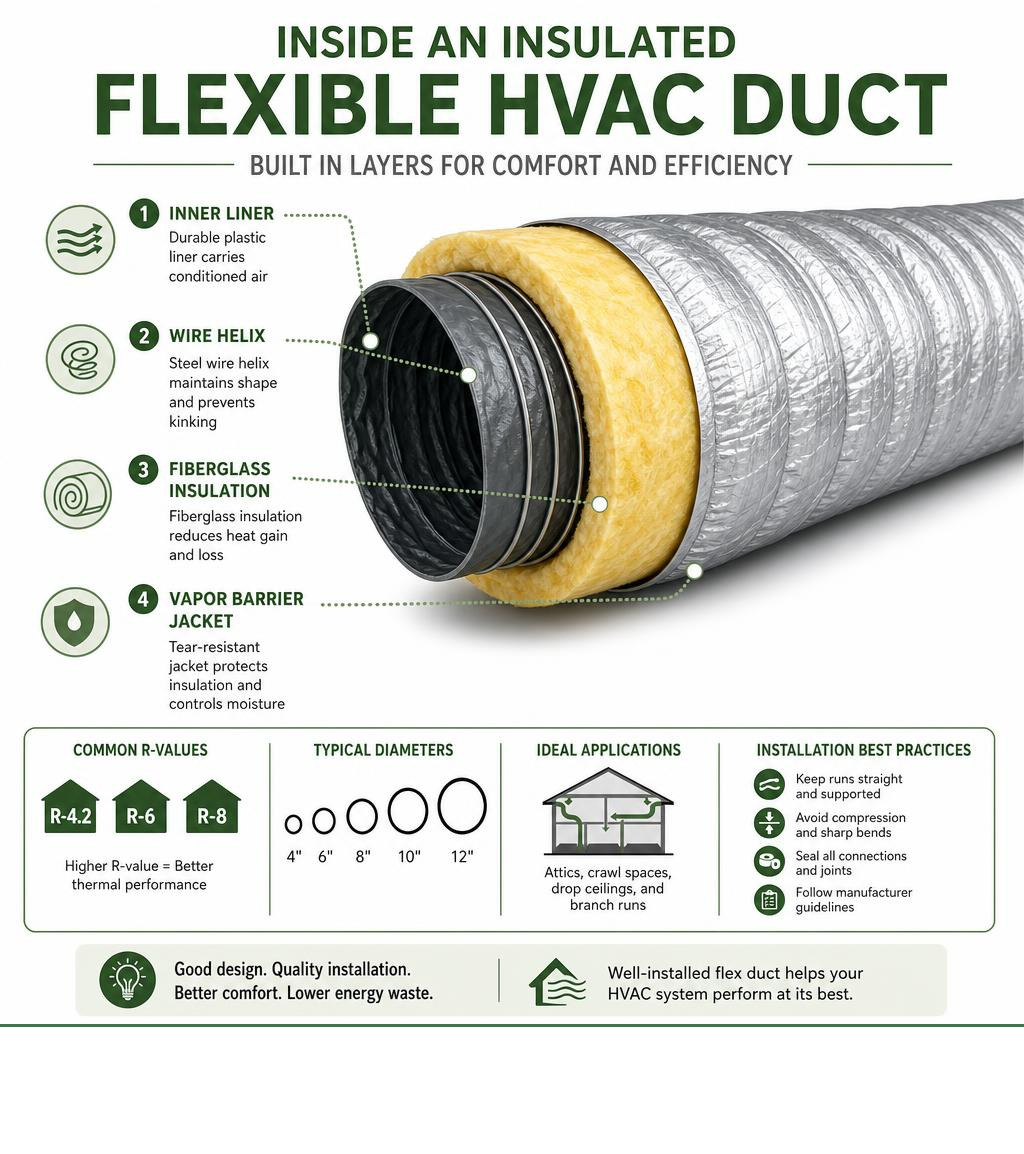
| How it works | An inner plastic liner supported by a wire helix carries airflow, wrapped in fiberglass insulation and a vapor barrier outer jacket |
| Common R-values | R-4.2, R-6, and R-8 |
| Typical diameters | 4″, 6″, 8″, 10″, and 12″ |
| Where it is used | Attics, crawl spaces, drop ceilings, and branch runs off main trunk lines |
| Key advantage | Easier and faster to install than rigid ductwork |
| Key risk | Compression, sharp bends, and poor sealing can reduce system efficiency by 10% to 40% |
When flex duct is designed and installed correctly, it performs well and helps deliver consistent comfort throughout your home. When it is not, the consequences are real. Studies estimate that poorly installed ductwork can reduce HVAC system efficiency by anywhere from 10% to 40%, which translates to hundreds of dollars in wasted energy costs every year on an average household utility bill.
This guide covers everything Central Texas homeowners need to know about flex duct, from how it is built and what types are available, to installation best practices, common mistakes, insulation requirements, and when to call a professional.
I am Chris Woods, owner of Woods Comfort Systems, a third-generation HVAC company serving homeowners across San Antonio, TX, Austin, TX, and surrounding communities since 1956, and I have seen how the quality of HVAC flex duct installation can make or break a system’s long-term performance. Whether you are evaluating duct options for a new installation or trying to understand why your current system is underperforming, this guide will give you the clarity you need.
To help you understand the terminology used in this guide, here is a key resource on installing a dedicated HVAC return air duct to balance system pressure and improve overall airflow.
To understand how flexible ductwork operates, it helps to look at its anatomy. Unlike rigid sheet metal ducts, which are solid, custom-fabricated tubes of galvanized steel, a standard flexible duct is constructed from three distinct layers:
While rigid metal ducts are highly durable and offer the least resistance to airflow, they are also heavy, expensive to fabricate, and labor-intensive to install. Flexible ductwork provides a highly adaptable alternative. However, because the inner liner has a natural spiral texture from the wire helix, it creates more friction loss than smooth sheet metal.
If the duct is compressed or allowed to sag, this friction increases dramatically. This is why proper design and installation are so critical. To see how these factors impact your monthly utility bills, gaining a clear understanding how ductwork affects your AC efficiency is essential for lowering utility bills.
| Duct Feature | Flexible Ductwork | Rigid Sheet Metal Ducts |
|---|---|---|
| Material | Plastic inner liner, wire helix, fiberglass, foil jacket | Galvanized steel or aluminum |
| Airflow Resistance | Higher (due to internal spiral ridges) | Very low (smooth interior surface) |
| Installation Ease | Fast, highly adaptable around framing | Labor-intensive, requires custom fabrication |
| Durability | Vulnerable to punctures, tears, and crushing | Highly durable, virtually indestructible if supported |
| Acoustics | Naturally dampens system noise | Can transmit equipment vibrations and air rushes |
| Airtightness | Excellent if sealed with draw bands and mastic | Requires manual sealing at every joint and seam |
Not all flexible ducts are created equal. Depending on where they are being installed and what function they serve in your residential HVAC or commercial ventilation system, you will need to choose the appropriate material and sizing options.
When evaluating these options, referring to manufacturer data such as the H&C Flex Duct technical specifications can help ensure you select a product rated for the correct velocity, temperature range, and static pressure of your system.
The most common type of flex duct used in home comfort systems is insulated flexible duct. Because these ducts are frequently routed through unconditioned spaces like attics, crawl spaces, and drop ceilings, they must be insulated to prevent thermal energy loss.
Without adequate insulation, the hot summer air in a Texas attic can quickly warm up the cool air traveling through your ducts, forcing your AC to run longer and work harder.
This insulation also serves another vital purpose: condensation prevention. When warm, humid air comes into contact with a cold, uninsulated duct surface, moisture condenses on the outside of the duct. Over time, this “sweating” can ruin drywall, destroy attic insulation, and encourage mold growth.
To prevent these issues, building codes require specific R-values depending on the location of the ducts. For deep-dive insights on optimizing your attic space against extreme temperatures, try consulting the definitive guide to attic insulation to optimize thermal performance.
While insulated ducts are the standard for supply and return air lines, non-insulated and semi-rigid options have distinct applications:
Because flexible duct is so easy to manipulate, it is also highly susceptible to poor installation practices. To ensure systems perform at their rated capacity, the Air Diffusion Council publishes strict installation standards.
Following these guidelines ensures that your HVAC flex duct operates with minimal airflow restriction and remains durable for decades. For a detailed look at industry-approved sealing methods, you can refer to the Building America Solution Center guide on sealing flex ducts to see step-by-step visual standards.
One of the most common installation errors is failing to support the ductwork properly, which leads to deep sags and pinched lines. When hanging flex duct horizontally, follow these structural rules:
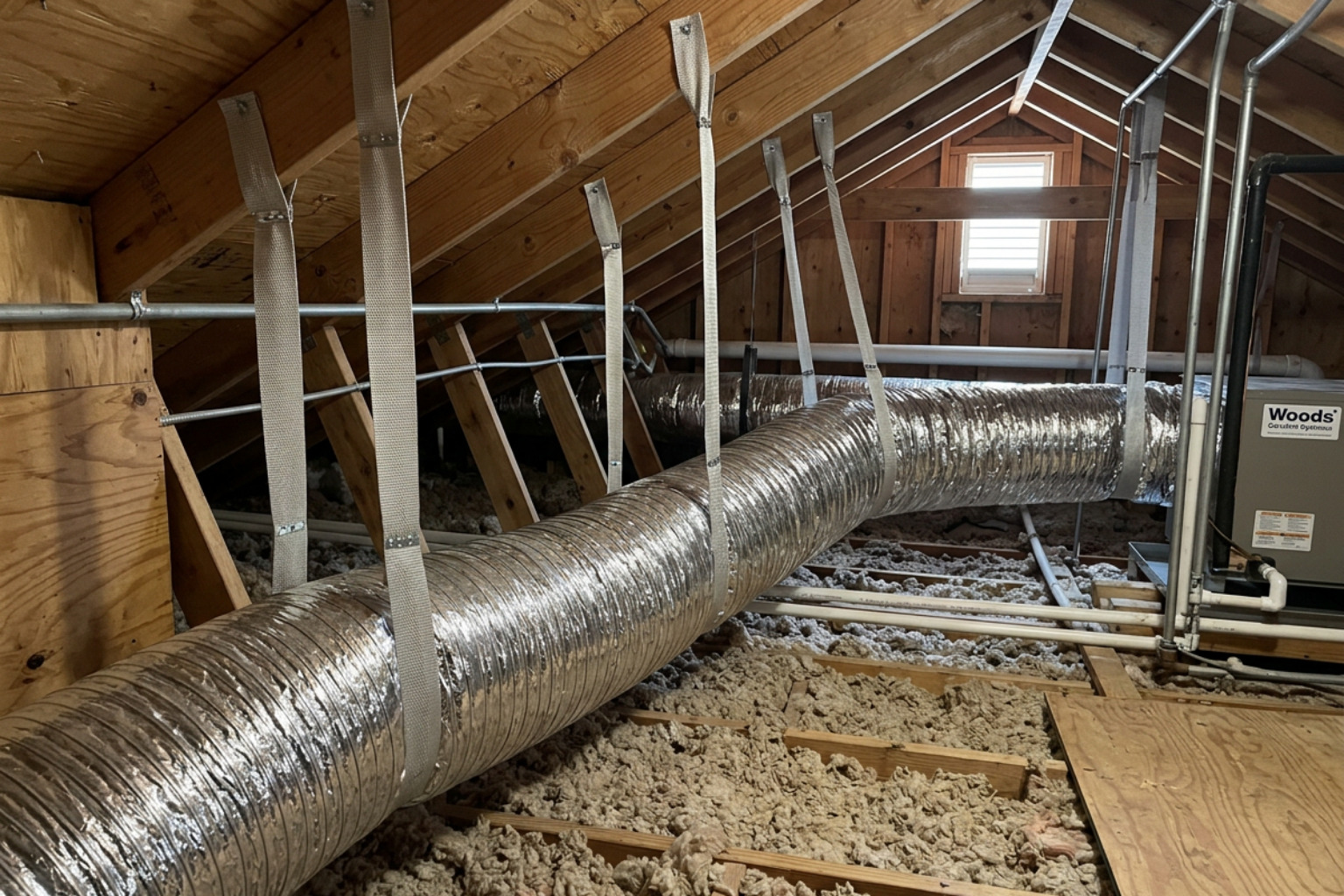
Proper support prevents the inner liner from bunching up and creating high static pressure, which is a major contributor to premature system wear. Homeowners can learn more about proactively preventing common ductwork problems to avoid restricted airflow and uneven temperatures.
A duct system is only as good as its connections. To prevent conditioned air from leaking into your attic or crawl space, every joint must be mechanically fastened and chemically sealed:
If your existing ductwork was put together with standard utility duct tape, it is highly likely that the adhesive has failed under attic heat. For a permanent fix, scheduling professional duct repair services to restore system integrity will ensure your connections are sealed according to modern building codes.
While some homeowners may consider installing or repairing flexible ductwork as a weekend DIY project, it is important to understand the risks involved. Working in tight, unconditioned spaces like attics or crawl spaces presents safety hazards, including extreme heat, exposed electrical wiring, and structural framing obstacles. Furthermore, achieving an airtight seal requires specialized tensioning tools and UL-181 approved materials that are not typically found in a standard household toolbox. If safety concerns arise, if you lack the specialized tools required, or if you are unsure about performing the task correctly, it is always best to contact a licensed professional. Because HVAC systems are complex and highly sensitive to pressure changes, professional installation ensures your system operates safely and at peak efficiency.
When flexible ductwork is compressed, kinked, or allowed to sag, the inner liner bunches together, creating massive friction loss. This restriction acts like a kink in a garden hose, forcing your blower motor to work much harder to push air through the system.
Consider this real-world scenario: if a home in San Marcos, TX has a standard 2.5-ton AC system moving 1,000 CFM of air, and the ducts have a typical 10% leakage rate, the system loses 100 CFM of conditioned air every single minute. That equates to roughly 3,000 BTUs of cooling capacity lost directly to the unconditioned attic or crawl space every single hour.
This loss forces your system to run longer cycles, driving up your monthly utility bills and putting unnecessary wear and tear on your compressor. To understand the true financial impact of these invisible air leaks, try learning how poorly installed ductwork costs you more in monthly energy waste.
While flexible duct is incredibly versatile, it is not suitable for every location in your home. Knowing where it can safely go and where it must be avoided is crucial for both system performance and home safety.
Safe and Recommended Locations:
Locations to Avoid:
If you are unsure whether your current duct layout is safe or efficient, scheduling a professional inspection is the best way to get answers. Take the time for recognizing the importance of regular duct inspections for indoor air quality to keep your family safe and your utility bills low.
On average, high-quality flexible ductwork lasts between 10 to 15 years. Over time, extreme attic temperatures, humidity cycles, and pest activity can degrade the outer plastic jacket and compress the fiberglass insulation, signaling that it is time for a replacement.
Yes, but it requires specialized equipment and a gentle touch. Traditional rigid metal duct cleaning tools, like heavy-duty rotary brushes, can easily tear the thin inner plastic liner of a flex duct. Professional technicians use specialized air whips or soft-bristled brushes designed specifically for flexible systems.
Sweating occurs when warm, humid attic air comes into contact with the cold surface of a duct carrying air-conditioned air. This is usually caused by thin or compressed insulation (low R-value) or a tear in the outer vapor barrier that allows humid air to reach the cold inner liner.
According to regional energy codes, supply ducts located in unconditioned spaces like attics must be insulated to at least R-8. Return ducts in unconditioned spaces must be insulated to at least R-6 to maintain thermal efficiency and prevent condensation.
Even minor compression can drastically restrict airflow. If a flexible duct is compressed by just 15% of its original diameter, the airflow capacity can drop by up to 50% due to increased static pressure and friction loss inside the bunched-up inner liner.
No. Despite its name, standard cloth-backed duct tape should never be used on HVAC ducts. The adhesive dries out and fails quickly under attic heat. Building codes require UL-181 approved foil tape or liquid mastic sealant for all connections.
Industry standards recommend limiting individual flexible duct runs to a maximum of 14 to 25 feet. For longer distances, a rigid metal trunk line should be installed, with short flex duct runs branching off to reach the individual registers.
The centerline bend radius of a flexible duct should never be less than one duct diameter. For example, if you are installing an 8-inch diameter duct, any bend or turn must have a radius of at least 8 inches to prevent kinking and airflow restriction.
Common signs include uneven cooling between rooms, a sudden increase in utility bills, visible tears or sagging in the attic, and dust or debris blowing out of your registers. A professional pressure test can verify if your ducts have excessive leakage.
Yes, flexible ducting is fully approved by the International Residential Code (IRC) and local TX building codes, provided it is UL-181 listed, properly insulated for the climate zone, and installed according to manufacturer specifications.
Flexible HVAC ductwork is a fantastic, cost-effective solution for home comfort, but only when it is treated with the care and precision it deserves. From choosing the correct R-value to ensuring hanger straps are wide enough and every connection is sealed with UL-181 mastic, proper installation is the key to maximizing your system’s longevity, maintaining great indoor air quality, and keeping your energy bills low.
Whether you need fast AC repairs, seasonal HVAC maintenance, or a complete system replacement, the team at Woods Comfort Systems is ready to help. Schedule your professional HVAC ductwork services today to bring lasting comfort back to your home.