
Why the Compressor Type in Your AC Matters More Than You Think
When comparing single stage vs two stage AC systems, here is the short answer:
| Feature | Single-Stage AC | Two-Stage AC |
|---|---|---|
| Capacity | 100% or off | ~65-70% (low) or 100% (high) |
| Energy efficiency | Lower (14-16 SEER2) | Higher (16-19 SEER2) |
| Humidity control | Basic | Better |
| Temperature consistency | 4-6°F swings | 2-3°F swings |
| Noise level | Louder | Quieter on low stage |
| Upfront cost | Lower | Higher |
| Lifespan | 12-15 years | 15-20 years |
| Best for | Mild climates, tight budgets | Hot, humid climates like San Marcos, TX |
Bottom line: A two-stage AC is the better fit for most San Marcos, TX homeowners because of the heat, humidity, and long cooling seasons. A single-stage unit costs less upfront but runs at full capacity every time it kicks on, which can add up on your energy bill and put more strain on the system.
San Marcos, TX summers are no joke. Temperatures regularly push past 100°F, and the humidity makes it feel even worse. Your air conditioner is not just fighting heat. It is fighting moisture, long cooling cycles, and a thermostat that barely gets a break from May through September.
That is exactly why the type of AC compressor you choose makes such a big difference here. A system that works fine in a mild Pacific Northwest climate can fall short in Central Texas, where your AC runs hard for months on end. The wrong choice can mean higher energy bills, uneven cooling, sticky indoor air, and a system that wears out faster than it should.
At Woods Comfort Systems, our third-generation HVAC team has served Central Texas since 1956. Over the decades, we have helped countless homeowners navigate the single stage vs two stage AC decision, and we know how much the right choice depends on your local climate, home size, and long-term goals. In the sections below, we will walk you through everything you need to know to make a confident decision for your home.
Understanding Compressor Technology: Single Stage vs Two Stage AC
To make the best choice for your home, it helps to understand what is happening inside the outdoor cabinet. The compressor is the heart of your AC system, responsible for pumping refrigerant through the coils to extract heat from your indoor air. How that compressor operates determines your comfort level and your monthly utility bills.
Compressor staging refers to the capacity levels at which your air conditioner can run. Selecting a system with matching components and appropriate staging technology is important for energy savings, comfort, and reliable operation.
When your AC is properly configured for your home, the compressor staging works in harmony with your indoor air handler to deliver steady comfort. However, even the most advanced staging technology will fail to perform if the equipment is not sized correctly. Load calculations matter because the right size air conditioning system for your home helps staging technology run long enough to control both temperature and humidity.
How Single-Stage AC Systems Work
A single-stage AC is the traditional model that most homeowners are familiar with. It operates on a simple on-and-off principle, much like a standard light switch. When your thermostat detects that the indoor temperature has risen above your set point, it signals the AC to turn on.
Once activated, a single-stage compressor runs at 100% capacity. It stays at full capacity until the indoor temperature drops to the thermostat setting, and then it shuts off completely. There is no middle ground. It is either running at maximum power or it is completely silent.
Because it only operates at full capacity, a single-stage system cools your home in short, intense bursts. This frequent cycling can lead to noticeable temperature swings of 4 to 6 degrees Fahrenheit. While single-stage systems are highly reliable and have fewer complex electronic parts, they can struggle in larger homes or multi-level properties. If you are considering this budget-friendly option, a professional load calculation helps prevent excessive short-cycling.
How Two-Stage AC Systems Work
A two-stage AC system features a compressor that can operate at two distinct capacity levels. Think of it like a two-setting light switch with a low and a high setting.
- Low Setting: The system operates at roughly 60% to 70% of its maximum cooling capacity.
- High Setting: The system runs at 100% capacity to handle extreme heat.
During most of the cooling season, a two-stage AC runs on its lower setting. In fact, on typical summer days in San Marcos, TX, a two-stage unit can meet your cooling needs on low speed much of the time. Because it runs at a lower capacity, it operates for longer, more continuous cycles rather than constantly turning on and off.
When the outdoor temperature spikes during the hottest afternoon hours, the system automatically shifts into high gear to keep your home comfortable. Once the peak demand passes, it transitions back down to the lower stage. This dual-capacity operation is one of the key benefits of energy efficient AC system San Marcos, TX homeowners can take advantage of to lower their summer utility bills.
Variable-Speed AC Systems Explained
Variable-speed systems represent the peak of modern HVAC technology. Instead of having one or two operating speeds, these systems use inverter-driven compressors that can make micro-adjustments in real time.
A variable-speed compressor can modulate its output in tiny increments, often operating anywhere from 25% to 100% capacity. It runs almost continuously at very low speeds, matching the exact cooling load of your home at any given second. If a cloud passes over your house or the sun starts to set, the compressor slows down slightly. If you open the back door or start cooking in the kitchen, it ramps up just enough to offset the added heat.
Because they avoid the large energy spikes associated with starting up a compressor from a complete stop, variable-speed units are incredibly efficient. Investing in a high-efficiency inverter model is an excellent path toward securing a highly energy efficient AC unit San Marcos, TX families can count on for consistent comfort and whisper-quiet performance.
Comparing Performance, Comfort, and Humidity Control
When deciding on a new AC, daily comfort is just as important as long-term savings. In Central Texas, comfort is determined by three main factors: temperature consistency, airflow quality, and indoor humidity control.
If your air conditioner is too large or operates on a simple single-stage compressor, it will cool your home too quickly without running long enough to pull moisture out of the air. This results in a cold, clammy indoor environment. An oversized AC system reduces efficiency and comfort by short-cycling, which is why matching the staging technology to your home’s actual thermal load is so essential.
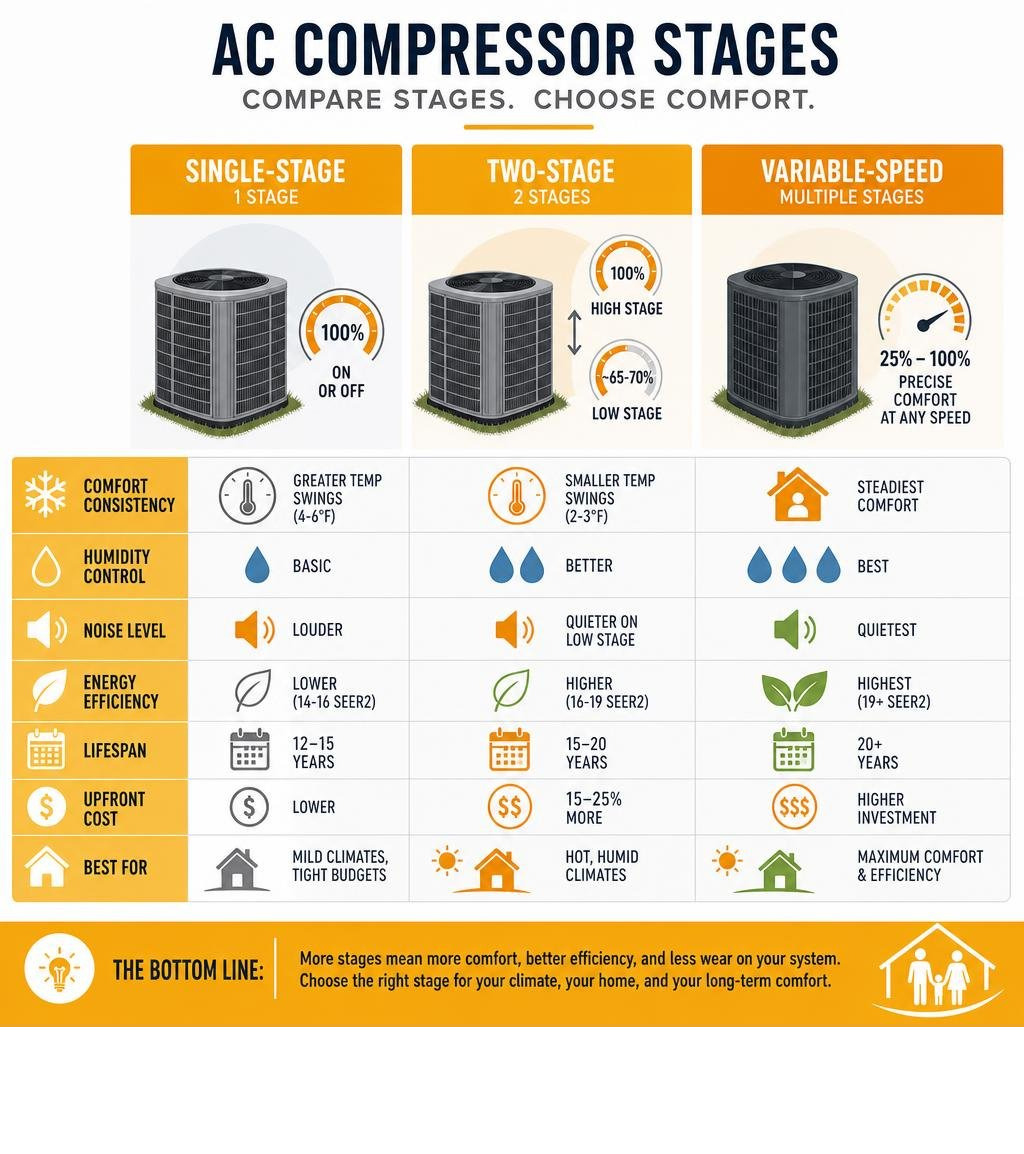
The table below provides a quick comparison of how single-stage, two-stage, and variable-speed systems perform across these key comfort metrics:
| Comfort Metric | Single-Stage AC | Two-Stage AC | Variable-Speed AC |
|---|---|---|---|
| Temperature Control | Cycles on and off, creating noticeable warm and cool spots. | Maintains highly consistent temperatures with minimal variance. | Delivers precise, near-perfect temperature matching within 0.5°F. |
| Humidity Removal | Basic moisture removal due to short cooling cycles. | Enhanced dehumidification because of longer, gentler run times. | Superior moisture control with dedicated dehumidification modes. |
| Acoustic Comfort | Louder startup sounds and high-velocity airflow noise. | Very quiet operation when running in the lower stage. | Virtually silent, running continuously at a low, steady hum. |
Humidity Control Differences in Single Stage vs Two Stage AC
Humidity control is where the difference between a single-stage and a two-stage AC becomes incredibly obvious. Air conditioners do not just cool the air, they also act as dehumidifiers. As warm, humid air passes over the cold evaporator coil, moisture condenses on the coil and drains away.
For this process to work effectively, the AC needs to run for a sustained period. Because a single-stage system runs at 100% capacity, it cools the air quickly and shuts off before it has a chance to remove much moisture. This leaves you with cold but sticky indoor air, which often tempts homeowners to lower the thermostat even further, driving up energy bills.
A two-stage AC solves this problem by running longer cycles on its lower setting. Because the air moves over the cold coils at a slower, steadier pace, the system can extract more moisture from your indoor air than a single-stage unit. This superior dehumidification keeps your home feeling comfortable even at slightly higher thermostat settings, while also helping with mold prevention in tightly sealed homes.
Temperature Consistency and Noise Levels
Single-stage systems are notorious for creating hot spots, particularly in two-story homes or rooms with large, west-facing windows. When the system shuts off, the air stops moving, allowing heat to build up in specific areas before the next cooling cycle begins.
A two-stage system provides much more consistent airflow. Because it runs on low speed for extended periods, it keeps air circulating continuously throughout your home. This constant circulation mixes the air thoroughly, eliminating drafts and balancing temperatures between different floors and rooms.
Continuous, low-stage operation also makes a massive difference in noise levels. Single-stage units make a loud, distinct clunk when the compressor kicks on at full power, accompanied by the rush of high-velocity air through your registers. A two-stage unit starting up on its lower setting is incredibly quiet, often operating at decibel levels lower than a normal indoor conversation. If you are trying to decide between a centralized multi-stage system and alternative cooling methods, the differences between central AC vs ductless mini split San Marcos, TX options can help you find the quietest, most effective solution for your layout.
Energy Efficiency and Financial Analysis
When evaluating a new AC system, it is important to look at both the immediate costs and the long-term impact on your household budget. While advanced staging technology carries a higher initial price tag, the monthly energy savings can help offset that investment over time.
Energy efficiency is measured by the Seasonal Energy Efficiency Ratio 2 (SEER2) rating. The higher the SEER2 rating, the less electricity the system uses to cool your home. Single-stage systems generally offer lower efficiency than comparable two-stage models, while variable-speed systems often provide the highest efficiency of the three options.
Upgrading from a standard single-stage system to a two-stage model can reduce cooling-related electricity use because the system spends more operating time in its lower stage. In a climate like San Marcos, TX, where the AC runs for a significant portion of the year, those savings can add up over time and help offset the additional equipment cost.
Upfront Costs vs. Long-Term Savings
The initial investment for a new AC installation depends on several factors, including the size of your home, the condition of your existing ductwork, and the complexity of the installation. Generally, a two-stage air conditioner costs more upfront than a comparable single-stage model of the same capacity.
While the initial purchase price of a single-stage system is lower, it is important to consider the total cost of ownership over the life of the system. The lower monthly utility bills provided by a two-stage system mean that the initial price difference may be recovered through energy savings, especially in a long cooling season.
When planning your budget, it is always a good idea to discuss installation variables with a professional so you can make an informed financial decision based on your home, comfort goals, and existing HVAC setup.
Lifespan and Maintenance Requirements for Single Stage vs Two Stage AC
The way an AC compressor operates has a direct impact on how long it lasts. The most stressful moment in an air conditioner’s operating cycle is the startup sequence. Starting a compressor from a complete stop draws a large spike of electricity and subjects the internal components to mechanical strain.
Because single-stage systems cycle on and off frequently throughout the day, they experience a high volume of these high-stress startups. This constant cycling accelerates wear and tear on critical electrical and mechanical parts, such as capacitors, contactors, and the compressor motor itself. With proper maintenance, a single-stage AC can provide reliable service for many years.
In contrast, a two-stage AC runs longer, gentler cycles on its lower setting, resulting in far fewer starts and stops. This reduced strain may help extend system life when the equipment is properly sized, installed, and maintained.
Regardless of the system type you choose, regular preventative maintenance is essential to protect your investment. Annual tune-ups, filter changes, and professional inspections will keep your system running at peak efficiency. For homes that need a complete cooling upgrade, professional AC installation services can help match the right staged system to your home, ductwork, and comfort goals.
Ductwork also plays a major role in whether a single-stage or two-stage AC performs as expected. Leaky, undersized, or poorly balanced ducts can limit airflow, create hot spots, and reduce the comfort benefits of a higher-efficiency system. If your home has uneven rooms or airflow concerns, Woods Comfort Systems can evaluate whether ductwork services should be part of your AC replacement plan.
Choosing the Right System for Your San Marcos, TX Home
Every home in Central Texas is unique, which means there is no single correct answer when choosing between a single-stage and a two-stage AC. The right choice for your family depends on several practical factors:
- Climate and Humidity: If you live in an area with high summer humidity, a two-stage or variable-speed system is almost always worth the investment for its superior moisture removal capabilities.
- Home Size and Layout: Multi-level homes, houses with open floor plans, or properties with large, sunny living areas benefit significantly from the balanced airflow of a two-stage system. Smaller, single-story homes can often be kept comfortable with a properly sized single-stage unit.
- Duration of Ownership: If you plan to stay in your current home for several more years, a two-stage system may make sense because you will have more time to benefit from lower monthly energy bills. If you plan to sell the property soon or are replacing a system in a rental home, a single-stage unit may be the more practical choice.
- Budget Constraints: If keeping your upfront costs as low as possible is your primary priority, a single-stage system delivers reliable, straightforward cooling at an affordable entry point.
Proper sizing is just as important as compressor staging. A system that is too large can cool quickly but fail to remove enough humidity, while a system that is too small may run constantly and still struggle on peak summer afternoons. For many San Marcos, TX homeowners, comparing staging options starts with the home’s size, duct condition, insulation, and sun exposure.
Choosing the right AC unit size for a San Marcos, TX home requires more than square footage alone because window exposure, insulation, air leaks, duct design, and household comfort preferences all affect the final recommendation. Homeowners comparing nearby Central Texas options can also use AC installation options and costs in Austin, TX to understand how local home styles and installation details can influence system selection.
Frequently Asked Questions about AC Compressor Stages
What is the main difference between single-stage and two-stage AC units?
A single-stage AC compressor operates at only one speed, which is 100% capacity. It is either fully on or completely off. A two-stage AC compressor has two operating levels, typically running at a lower setting of 60% to 70% capacity for mild days and shifting to 100% capacity only when extreme heat demands it.
Is a two-stage AC worth the extra cost in San Marcos, TX?
Yes, for most homeowners in San Marcos, TX, a two-stage AC is well worth the investment. The severe summer heat and high humidity levels mean your system runs constantly. A two-stage unit provides significantly better humidity control, more consistent indoor temperatures, and lower monthly utility bills, allowing you to recover the extra upfront cost over time.
How much energy can I save by upgrading to a two-stage AC?
Upgrading from an older, standard single-stage AC to a modern two-stage system can reduce your cooling-related electricity usage by approximately 25% to 30%. This is because the system spends the majority of its operating hours running in its highly efficient lower stage, avoiding the frequent, high-energy startup spikes associated with single-stage units.
Do two-stage AC units last longer than single-stage models?
Generally, yes. Two-stage systems typically last 15 to 20 years, compared to the 12 to 15-year average lifespan of a single-stage unit. Because a two-stage compressor runs longer, gentler cycles, it starts and stops far less frequently, which significantly reduces wear and tear on the electrical and mechanical components.
What is a variable-speed AC and how does it compare?
A variable-speed AC uses an inverter-driven compressor that can continuously adjust its operating speed in tiny increments, usually ranging from 25% to 100% capacity. While a two-stage system has two fixed speeds, a variable-speed system makes constant micro-adjustments to match your home’s exact cooling load, offering the highest efficiency and most precise comfort available.
Can I use my existing thermostat with a two-stage AC?
It depends on your current thermostat. A two-stage AC requires a thermostat that is specifically designed to control two stages of cooling, which involves extra wiring. If you have an older, single-stage thermostat, it will need to be upgraded to a compatible smart thermostat or multi-stage controller to unlock the benefits of your new system.
How does compressor staging affect indoor humidity?
Compressor staging has a major impact on humidity. Because a single-stage system cools your home quickly at full blast, its cycles are short, meaning it does not run long enough to pull much moisture from the air. A two-stage system runs longer, slower cycles on its lower setting, allowing the indoor air handler to continuously draw moisture out of your home, keeping the indoor air crisp and dry.
Are two-stage air conditioners quieter than single-stage units?
Yes, two-stage systems are noticeably quieter. When running on the lower stage, the compressor operates under less pressure and the indoor blower fan runs at a lower speed. This eliminates the loud startup clunks and high-velocity wind noise common with single-stage systems, resulting in a much quieter indoor and outdoor environment.
Which system is better for a multi-level home in Texas?
A two-stage or variable-speed system is highly recommended for multi-level homes in Texas. Single-stage systems struggle to balance temperatures between floors, often leaving the upstairs hot and stuffy while the downstairs is freezing. The continuous, low-speed airflow of a two-stage system keeps air circulating constantly, which helps eliminate hot spots and balances temperatures between floors.
How do I know what size AC unit my home needs?
The only way to accurately determine the correct AC size is through a professional load calculation, such as a Manual J calculation. This assessment takes into account your home’s square footage, local climate, insulation levels, window orientation, and ductwork design to match your property with a system that is sized perfectly for your needs.
Conclusion
Choosing between a single-stage and a two-stage AC is one of the most important decisions you will make when replacing your home’s cooling system. While a single-stage system offers a lower upfront cost and reliable performance, a two-stage system provides the enhanced energy efficiency, superior humidity control, and consistent comfort that makes Central Texas summers much more manageable.
At Woods Comfort Systems, we have spent more than six decades keeping our neighbors throughout Central Texas comfortable in their homes. Our experienced, family-owned team is committed to providing you with honest advice, royal customer treatment, and professional installation services tailored to your unique budget and home layout. If you are ready to upgrade your home comfort, contact our professional AC technicians to schedule your free in-home consultation.