


Why Your AC’s SEER Rating Directly Affects Your Energy Bill
AC SEER rating explained simply: it is the number that tells you how efficiently your air conditioner uses electricity to cool your home. The higher the number, the less energy your system burns to deliver the same amount of cooling.
Here is a quick summary:
| SEER Rating | Efficiency Level | Best For |
|---|---|---|
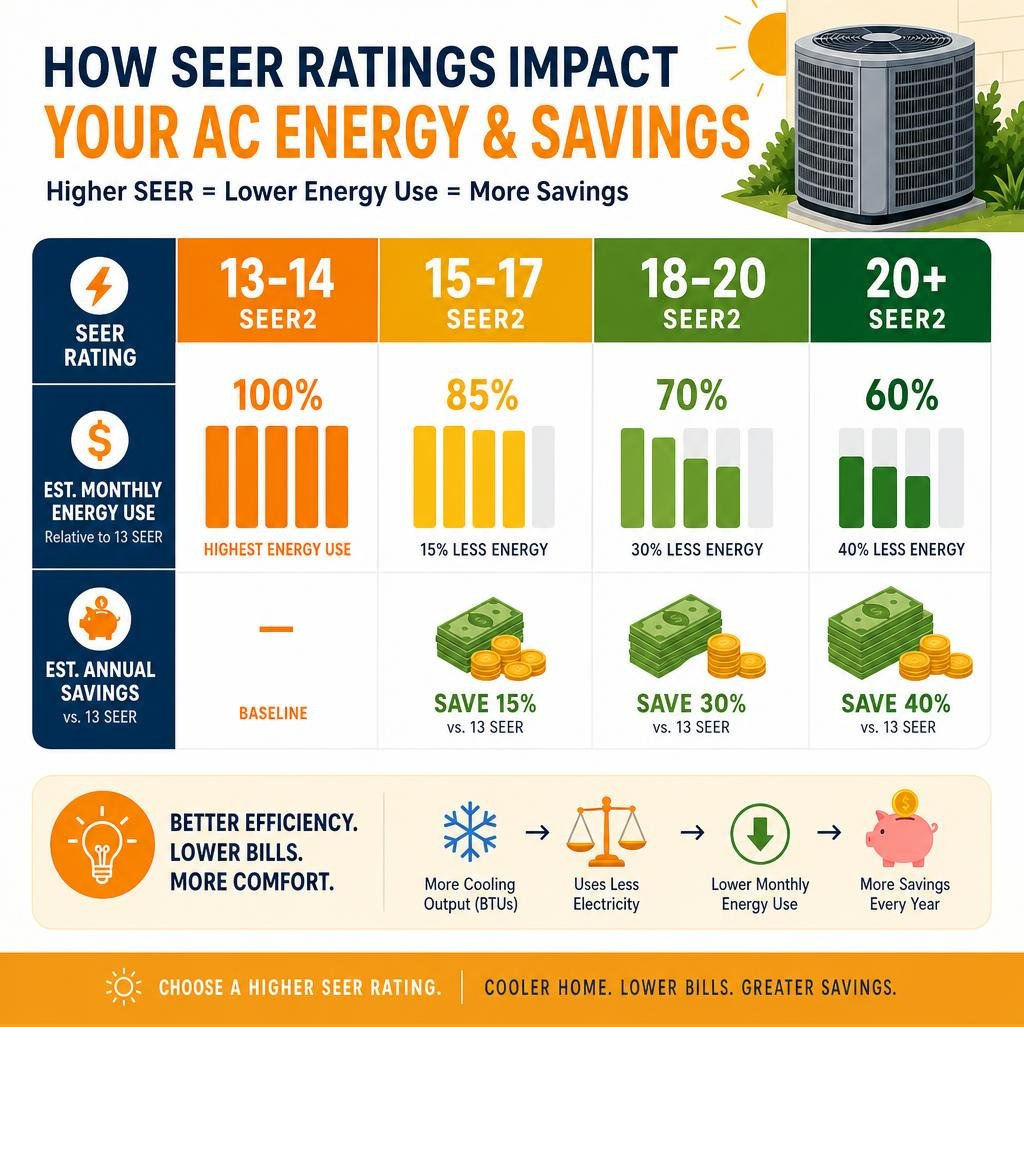
| 13-14 SEER2 | Minimum / Standard | Mild climates, tight budgets |
| 15-17 SEER2 | Mid-Range / Good | Most homes, moderate climates |
| 18-20 SEER2 | High Efficiency | Hot climates, frequent AC use |
| 20+ SEER2 | Premium | Texas summers, maximum savings |
- SEER stands for Seasonal Energy Efficiency Ratio
- It measures cooling output, in BTUs, divided by electricity used, in watt-hours, over a full cooling season
- Higher SEER generally means lower monthly energy bills
- As of 2023, new AC systems in Texas must meet a minimum of 14.3 SEER2
- Upgrading from an older, lower-efficiency system to a modern higher-SEER system can significantly reduce cooling energy use
For Central Texas homeowners, where air conditioners run hard for months at a time, even a modest jump in SEER rating can translate to noticeable savings on your utility bill every summer.
At Woods Comfort Systems, our HVAC team brings more than six decades of family experience serving San Antonio, TX, Austin, TX, San Marcos, TX, and surrounding communities. We help homeowners understand the AC SEER rating explained question so they can choose the right system for their home, comfort needs, and long-term energy goals.
AC SEER Rating Explained: What Does the Number Actually Mean?
To understand what a SEER rating actually represents, it helps to think of it as the HVAC equivalent of a car’s highway fuel economy. Just as a vehicle’s miles per gallon rating tells you how far you can drive on a single gallon of gasoline, an AC unit’s SEER rating tells you how much cooling comfort you get for every watt of electricity you purchase.
SEER stands for Seasonal Energy Efficiency Ratio. It is a standardized metric designed to evaluate the energy efficiency of residential air conditioners and heat pumps. This rating does not measure how cold the air coming out of your vents will be. Instead, it measures how much electrical energy the system must consume to achieve that cool temperature.
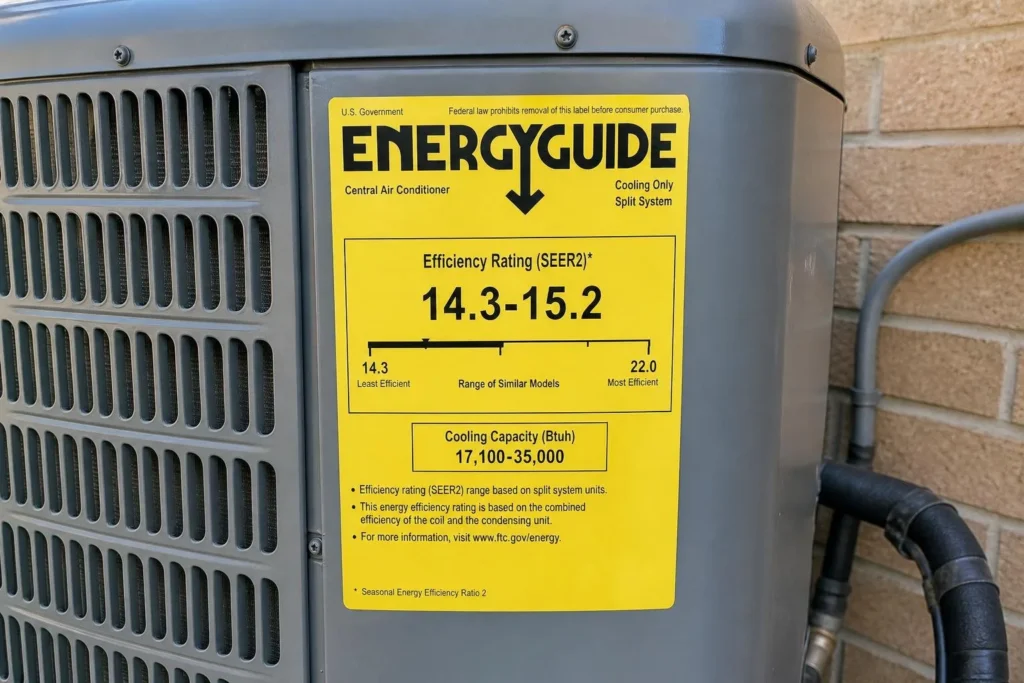
Older air conditioning systems, particularly those installed in the early 2000s, typically operated at ratings of 8 to 10 SEER. Today, modern engineering allows residential systems to reach ratings well over 20 SEER. When you are shopping for a new cooling system, you will find this rating clearly displayed on the yellow EnergyGuide label affixed to the outdoor condenser unit. Understanding how to read this label is the first step toward taking control of your home’s energy consumption. For a deeper look at this sticker, our article on understanding the EnergyGuide label explains how these numbers are organized.
The Mathematical Formula Behind the Rating
Behind every SEER rating is a specific mathematical calculation established by the Air Conditioning, Heating, and Refrigeration Institute. The ratio is calculated by dividing the total cooling output of the system during a typical cooling season by the total electric energy input during that same time period.
Mathematically, the formula looks like this:
SEER = Total Seasonal Cooling Output (in British Thermal Units, or BTUs) / Total Electrical Energy Input (in Watt-Hours)
To determine this number, manufacturers subject their equipment to a cooling season simulation in controlled laboratory environments. The testing simulates a full season of weather, with outdoor temperatures ranging from 65 degrees Fahrenheit up to 104 degrees Fahrenheit, while maintaining a constant indoor temperature. By measuring how many BTUs of heat the system can remove from the air relative to the watt-hours of electricity it draws across these varying temperatures, engineers establish the official SEER rating.
How to Find Your Current Air Conditioner’s SEER Rating
If you are trying to decide whether it is time to upgrade your system, you first need to establish your baseline by finding the SEER rating of your current unit.
There are three primary ways to locate this information:
- Check the condenser sticker: Walk outside to your outdoor condenser unit and look for the yellow and black EnergyGuide label. If the system was installed in the last decade, this label should clearly state the SEER or SEER2 rating.
- Locate the manufacturer data plate: If the yellow sticker has faded or peeled off, look for the metal manufacturer data plate on the side of the outdoor unit. This plate lists technical specifications, including the model number and serial number.
- Use a model number lookup: Note down the model number from the data plate. The first few digits of the model number often hint at the capacity and efficiency. For example, a model number starting with “14AC” might indicate a 14 SEER unit. You can enter this model number into the online AHRI directory or search the manufacturer’s website to find the exact rating.
If your system is more than 10 to 15 years old and you cannot find a rating, it is highly likely that your system operates between 8 and 10 SEER. Over time, wear and tear can degrade this efficiency even further, meaning your system is likely drawing far more power than it did when it was brand new.
SEER vs. SEER2 vs. EER: Key Differences Explained
When researching new cooling systems in 2026, you will quickly notice three different acronyms: SEER, SEER2, and EER. While they all measure efficiency, they do so under different conditions.
To keep them straight, it helps to look at how they compare side by side:
| Metric | Testing Conditions | What It Measures | Best Used For |
|---|---|---|---|
| SEER | Low external static pressure (0.1 in. w.c.) | Seasonal average efficiency across varying temperatures | General comparison of older or legacy systems |
| SEER2 | Realistic external static pressure (0.5 in. w.c.) | Real-world seasonal average efficiency with ductwork resistance | Evaluating all new systems manufactured after 2023 |
| EER | Steady-state at 95°F outdoor, 80°F indoor, 50% humidity | Peak-load efficiency during the hottest days | Comparing peak performance in hot, dry climates |
Why the Industry Shifted to SEER2
On January 1, 2023, the U.S. Department of Energy officially mandated a shift from the old SEER testing standard to a new, more rigorous testing standard known as SEER2.
Under the old SEER testing protocols, laboratory tests simulated home conditions using an external static pressure of only 0.1 inches of water column. In the real world, however, residential ductwork creates far more resistance to airflow. The average home’s ductwork actually creates a static pressure closer to 0.5 inches of water column.
Because the old testing did not account for this real-world ductwork resistance, the original SEER ratings were artificially high. The new SEER2 testing protocol, known as the M1 testing standard, forces manufacturers to test their systems at 0.5 inches of water column of static pressure, a fivefold increase.
Because the system blower has to work harder to push air against this realistic resistance, SEER2 ratings are approximately 4.5% to 5% lower numerically than traditional SEER ratings for the exact same physical equipment. For example, a system that was rated at 15 SEER under the old testing rules is rated at roughly 14.3 SEER2 today. It is not less efficient; the testing is simply more honest.
When EER Matters More Than SEER
While SEER and SEER2 measure seasonal averages, EER, or Energy Efficiency Ratio, measures steady-state efficiency. Instead of averaging performance across a range of spring and summer temperatures, EER tests the system at a single, grueling temperature point: an outdoor temperature of 95 degrees Fahrenheit, an indoor temperature of 80 degrees Fahrenheit, and 50% relative humidity.
EER tells you exactly how efficiently your air conditioner will perform during the absolute hottest hours of the summer. In hot and dry climates where summer temperatures regularly exceed 100 degrees Fahrenheit for weeks on end, EER is an incredibly important metric. While a high SEER2 rating ensures your system runs efficiently on a mild 80-degree spring day, a high EER rating helps keep electric bills more manageable when the Texas summer heat is at its peak.
Federal Minimum Requirements and Regional Standards
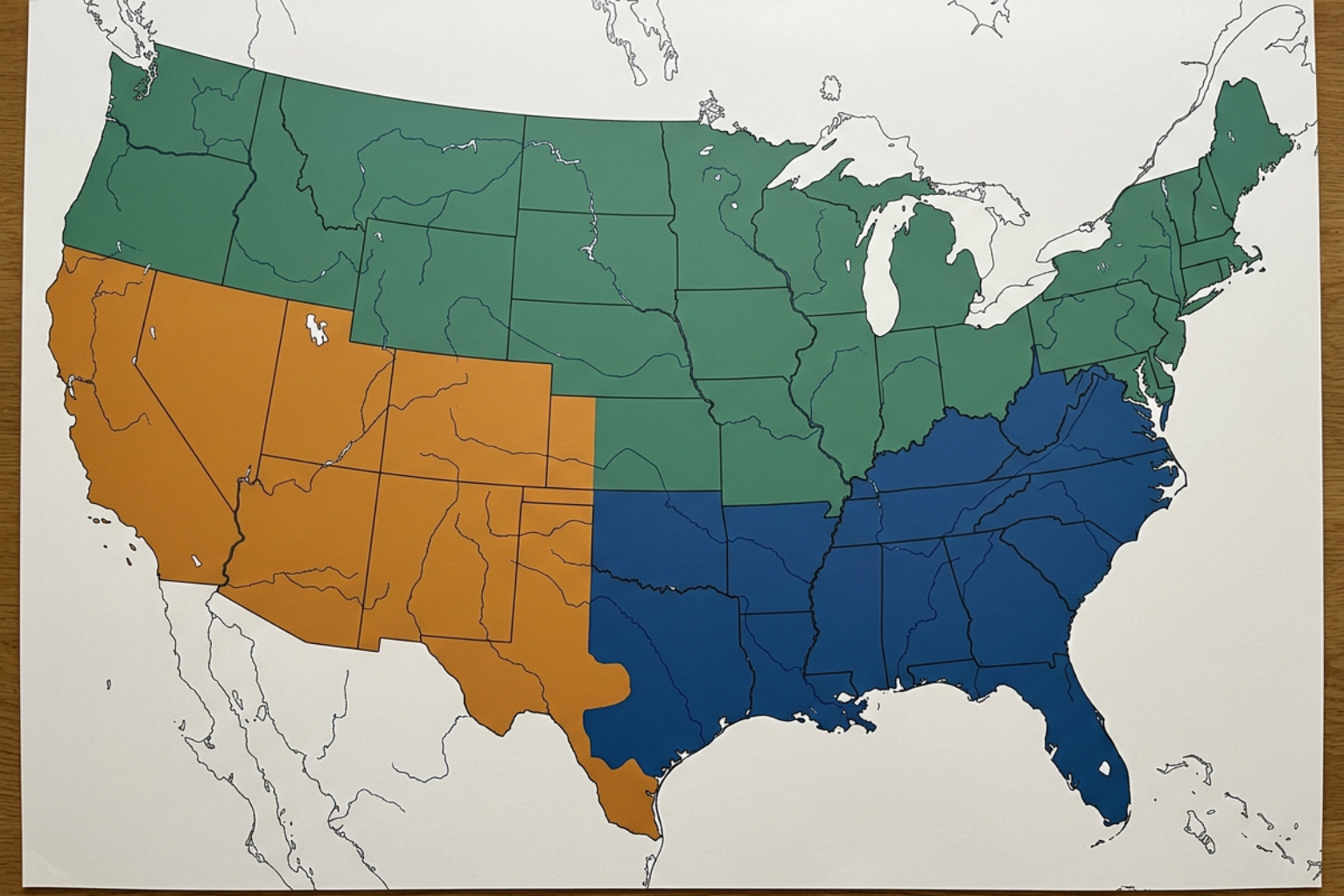
To reduce national energy consumption, the Department of Energy periodically raises the minimum allowable efficiency standards for newly manufactured residential air conditioners. Because different parts of the country experience vastly different climates, the federal government divides the United States into three distinct regional climate zones: the Northern region, the Southeast region, and the Southwest region.
The Northern region consists of states with shorter, milder cooling seasons, such as Michigan or South Dakota. In these states, the minimum efficiency requirement is set lower because air conditioners run for only a few months out of the year. The Southeast and Southwest regions, which include Texas, have much stricter standards due to the extreme cooling demands placed on local power grids.
Local Climate Impact: AC SEER Rating Explained for Texas Homes
For homeowners in communities like San Marcos, TX, Austin, TX, and San Antonio, TX, regional standards are highly demanding. Under current federal mandates, any split-system AC unit installed in the southern regions must meet a minimum efficiency rating of 14.3 SEER2, which is equivalent to 15 SEER under the old system.
If you are installing a heat pump instead of a traditional central AC, the standards are similarly high to ensure year-round efficiency. Because our local summers are incredibly long and humid, operating a system that merely meets the bare legal minimum is often not the most cost-effective long-term choice.
Investing in a system that goes beyond the federal minimums can reduce your monthly operating costs over time. Higher-efficiency equipment can be especially helpful for Central Texas homes where long cooling seasons put extra demand on the AC system.
How Much Can You Save by Upgrading to a Higher SEER Unit?
Upgrading to a high-efficiency cooling system is one of the most effective ways to lower your monthly utility bills. The amount of money you save depends directly on the efficiency leap between your old unit and your new one, as well as how often you run your system.
When you choose a high-efficiency system, you are often upgrading from standard single-stage compressors to advanced two-stage or variable-speed compressors. While a single-stage system is either 100% on or completely off, variable-speed systems can adjust their cooling capacity across a wider operating range. This allows them to run for longer periods at lower, highly efficient speeds, using less electricity while keeping indoor temperatures more consistent.
For homeowners comparing equipment options, our AC installation options and costs in Austin, TX article explains how different cooling systems fit various homes, comfort goals, and budgets.
Real-World Savings: 14 SEER vs. 16 SEER vs. 20 SEER
The financial impact of upgrading your AC efficiency can be substantial. Because higher SEER ratings reflect lower energy use for the same amount of cooling, the cumulative savings over a system’s lifespan can add up, especially in Central Texas. For a trusted manufacturer perspective on balancing efficiency and value, Trane’s article on what makes a good SEER2 rating explains why the right efficiency level depends on climate, system type, and long-term comfort goals.
To illustrate the potential savings, consider these general comparisons:
- Upgrading from 10 SEER to 16 SEER: This upgrade can significantly reduce your cooling system’s energy consumption. If your current system is old and runs frequently, the monthly savings can be noticeable during peak cooling season.
- Upgrading from 15 SEER2 to 20 SEER2: This transition can provide meaningful energy savings for homeowners looking to maximize monthly efficiency.
- Comparing 16 SEER to 18 SEER: An 18 SEER air conditioner uses less energy than a 16 SEER unit when both systems are properly sized and installed.
- Comparing 14 SEER to 20 SEER: A 20 SEER air conditioner is much more efficient than a base-level 14 SEER unit, which can lower seasonal cooling costs.
Calculating Your Potential Payback Period
To determine if a premium, high-SEER system is worth the higher upfront investment, you must calculate the payback period. The payback period is the amount of time it takes for your monthly utility savings to offset the extra cost of buying a more efficient unit.
To calculate this, you need to look at three primary factors:
- The price premium: How much more does the higher-SEER system cost to purchase and install compared to a standard-efficiency model?
- Annual cooling hours: In Central Texas, the cooling season often runs from April through October, resulting in high annual cooling hours. The more hours your system runs, the faster you can recoup your investment.
- Local electricity rates: Higher electricity rates mean greater cash savings for every kilowatt-hour of power you avoid using.
For example, if a higher-efficiency system costs more upfront but lowers annual cooling costs enough to offset that difference within several years, the investment may make sense for a homeowner who plans to stay in the home long-term. Since modern AC systems are designed to last many years when properly maintained, the best choice usually depends on your home, comfort priorities, and expected cooling use.
Other Crucial Factors to Consider When Buying a New AC
While understanding the AC SEER rating explained in this guide is vital, it is important to remember that a SEER rating is a laboratory measurement. In the real world, your air conditioner will only achieve its labeled efficiency if it is paired with proper system sizing, high-quality ductwork, and a flawless professional installation.
If you are planning an upgrade in the near future, the Woods Comfort Systems team can help you compare high-efficiency options through our professional AC installation services so the new system fits your home instead of relying on the SEER number alone.
Why Proper System Sizing Trumps the Highest AC SEER Rating Explained
One of the most common mistakes a homeowner can make is assuming that buying the system with the highest SEER rating will automatically guarantee the lowest energy bills. If an AC unit is not sized correctly for your specific home, its real-world efficiency will plummet.
To size a system correctly, a professional HVAC contractor must perform a comprehensive Manual J load calculation. This calculation takes into account your home’s square footage, insulation levels, window orientations, local climate, and layout.
If your system is oversized, it will suffer from a phenomenon known as short-cycling: turning on, cooling the home rapidly, and turning off before completing a full cycle. This constant cycling prevents the system from running long enough to remove moisture from the air, leaving your home feeling cool but incredibly humid. Our guide on whether your air conditioning system is the right size for your home explains how homeowners can recognize common sizing problems.
Furthermore, an oversized AC system draws heavy starting current during frequent start-ups, which can wipe out the theoretical savings you hoped to achieve with a high SEER rating.
The Impact of Ductwork and Maintenance on Real-World SEER
Your ductwork serves as the circulatory system of your home’s HVAC unit. If your ducts are poorly designed, unsealed, or improperly insulated, they will severely undermine your new system’s efficiency.
If airflow problems are limiting comfort, Woods Comfort Systems can inspect and improve the home’s ductwork so a high-efficiency AC system has the support it needs to perform as intended.
According to industry studies, the average residential duct system installed in unconditioned attic spaces experiences a thermal loss of 15% to 30%. This means that up to nearly a third of the cool air your highly efficient AC system produces is lost before it ever reaches your living spaces. High static pressure caused by restricted, crimped, or undersized ducts also forces your blower motor to work harder, consuming extra electricity and lowering your system’s operating efficiency.
Once your system is installed, ongoing preventative care is essential to protect your investment. Regular filter changes, coil cleanings, and electrical inspections prevent performance degradation over time. Our article on how air conditioner maintenance keeps your system running right explains why maintenance is so important for preserving comfort and efficiency.
Rebates, Tax Credits, and Financing for High-Efficiency Systems
Because high-efficiency systems significantly reduce the strain on local power grids and lower carbon emissions, there are numerous financial incentives available to help homeowners offset the upfront cost of an upgrade.
Under the federal Inflation Reduction Act, homeowners can claim the 25C Energy Efficient Home Improvement Credit. This tax credit allows you to deduct up to 30% of the installation cost of qualifying energy-efficient equipment directly from your federal taxes. For qualifying central air conditioners, the credit is capped at $600, while qualifying high-efficiency heat pumps can earn you a tax credit of up to $2,000. To qualify, systems must meet specific Energy Star and CEE efficiency tiers.
In addition to federal tax incentives, local municipal utilities in Central Texas, such as Austin Energy, CPS Energy in San Antonio, TX, and San Marcos Electric Utility, may offer rebates for homeowners who upgrade to high-SEER2 equipment. When you combine available utility rebates with manufacturer incentives and flexible financing options, upgrading to a premium-efficiency system can become more accessible. If you are preparing for a new installation, it is worth asking an HVAC professional which incentives currently apply to your home and equipment choice.
Frequently Asked Questions About AC SEER Ratings
What is a good SEER2 rating for a home in San Marcos, TX?
For homes in San Marcos, TX, and surrounding Central Texas communities, a SEER2 rating of 15 to 17 represents a strong, cost-effective range for standard efficiency. Because local summers are long and hot, upgrading to a high-efficiency system rated at 18 to 20+ SEER2 with a variable-speed compressor may be worthwhile for homeowners who plan to stay in their homes long-term, since it can support lower monthly energy use and better humidity control.
How much can I save by upgrading from a 14 SEER to a 16 SEER2 system?
Upgrading from a legacy 14 SEER system to a modern 16 SEER2 system can reduce cooling energy consumption, but actual savings depend on equipment sizing, duct condition, thermostat settings, local electricity rates, and how often the AC runs. In a hot Texas climate, even a modest efficiency improvement can add up over a long cooling season.
What is the difference between SEER and SEER2?
The primary difference lies in how the systems are tested. SEER2 uses the updated M1 testing procedure mandated by the Department of Energy in 2023. This newer standard tests equipment under higher external static pressure than the old SEER test to better simulate the airflow resistance of real-world home ductwork. As a result, SEER2 ratings are usually lower numerically than old SEER ratings for the same unit, but they represent a more accurate picture of real-world performance.
Does a higher SEER rating mean my home will cool down faster?
No. A SEER rating measures efficiency, not cooling speed or capacity. A 3-ton AC unit rated at 14 SEER and a 3-ton AC unit rated at 20 SEER have the same cooling capacity when properly matched to the home. The difference is that the higher-SEER unit uses less electricity to cool your home to your desired temperature.
What is the minimum SEER2 requirement for Texas in 2026?
In 2026, the federal minimum requirement for newly installed residential split-system air conditioners in Texas and the rest of the Southern region is 14.3 SEER2, which is equivalent to 15 SEER under the old system. Any system installed in this region must meet or exceed this standard to comply with Department of Energy regulations.
How do I find the SEER rating on my current air conditioner?
You can usually find the rating on the yellow and black EnergyGuide sticker located on your outdoor condenser unit. If that sticker is missing or illegible, look for the metal data plate on the side of the condenser, write down the manufacturer model number, and search for it online or look it up in the official AHRI directory.
Is it worth paying more for a 20 SEER2 variable-speed AC unit?
For many Central Texas homeowners, yes. While a 20 SEER2 unit has a higher upfront cost, its variable-speed compressor allows it to run for longer periods at lower speeds. This type of operation can improve indoor comfort, reduce noise, improve humidity control, and support stronger energy savings over the system’s lifespan.
What is the difference between SEER2 and EER2?
SEER2 measures the average efficiency of an air conditioner over an entire cooling season with varying outdoor temperatures. EER2 measures steady-state efficiency at a single, extreme outdoor temperature of 95 degrees Fahrenheit. SEER2 is best for estimating overall seasonal energy bills, while EER2 is useful for understanding how efficiently the system will perform during peak summer heat.
How does proper AC maintenance affect my system’s actual SEER performance?
Without regular maintenance, an air conditioner’s real-world efficiency can degrade significantly. Dirty coils, clogged air filters, low refrigerant charges, and neglected blower motors restrict airflow and force the system to work harder. This extra strain can make a high-efficiency system perform more like a lower-efficiency unit while raising energy bills and shortening the system’s lifespan.
What SEER2 ratings qualify for federal tax credits in 2026?
Under current 25C tax credit guidelines, qualifying split-system central air conditioners must meet Energy Star Most Efficient criteria, while qualifying heat pumps must meet the applicable CEE tier standards. Because eligibility can change and also depends on the exact matched equipment, homeowners should confirm the model with a qualified HVAC professional before counting on a tax credit.
Conclusion
Navigating efficiency standards can feel overwhelming, but finding the right cooling system for your home does not have to be a guessing game. Balancing upfront equipment costs, local utility rebates, and long-term energy savings is the key to finding a system that keeps your family comfortable without breaking the bank.
Because installing a new air conditioner involves complex electrical wiring, precise refrigerant handling, and specialized airflow calculations, it is a task that should always be left to licensed professionals. A poorly installed system will never achieve its rated efficiency, and improper installation can even void your manufacturer’s warranty.
Whether you need fast AC repairs, seasonal HVAC maintenance, or a complete system replacement, the team at Woods Comfort Systems is ready to help. Our family-owned team has kept Central Texas homes cool and comfortable for over 60 years with our signature royal customer treatment. To choose the right high-efficiency cooling system for your home, contact our professional AC technicians today.