


Why Your Home Feels Sticky Even With the AC Running
If your home has AC running but humid inside, you are not alone. It is a common comfort complaint for Central Texas homeowners, and it almost always has a fixable cause.
Quick Answer: Why Is My AC Running But the Air Still Feels Humid?
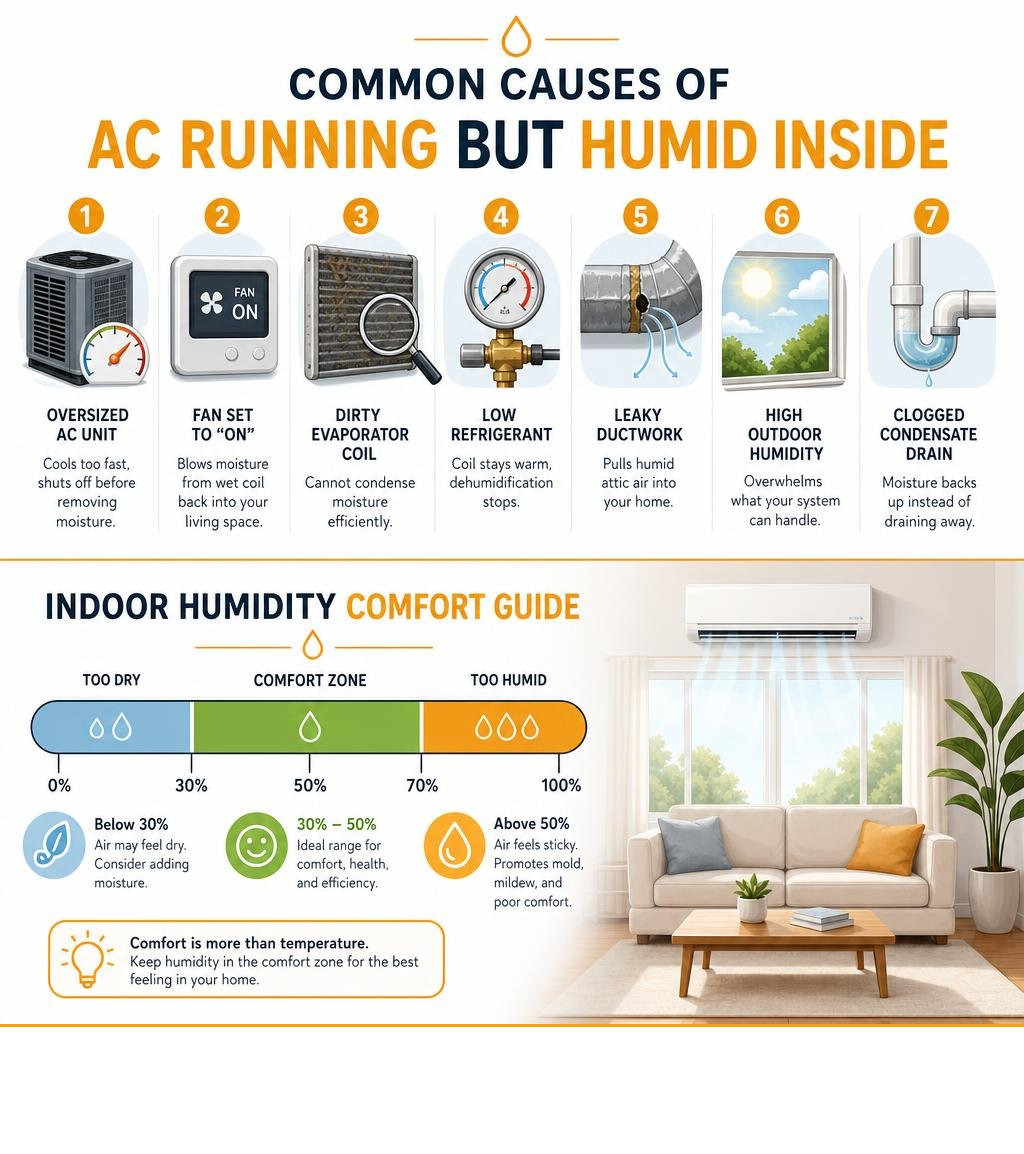
| Cause | What’s Happening |
|---|---|
| Oversized AC unit | Cools too fast and shuts off before removing moisture |
| Fan set to “On” | Blows moisture from the wet coil back indoors |
| Dirty evaporator coil | Cannot condense moisture efficiently |
| Low refrigerant | Coil stays warm, so dehumidification drops |
| Leaky ductwork | Pulls humid attic air into your home |
| High outdoor humidity | Adds more moisture than the system can handle |
| Clogged condensate drain | Moisture backs up instead of draining away |
Your AC has two jobs: cool the air and remove moisture from it. In Central Texas, where summer humidity can push well past 70% outdoors, moisture removal matters just as much as temperature control. When dehumidification fails, your home can hit the thermostat setting and still feel sticky because humid air slows sweat evaporation.
Our experienced HVAC team helps Central Texas homeowners solve AC running but humid inside problems throughout the summer. Below, we will walk through the common causes and practical fixes.
Why Is My AC Running But Humid Inside?
When you notice your AC running but humid inside, there is a disconnect between cooling and moisture removal. Warm air holds more water vapor than cold air. As your air conditioner cools the air, relative humidity can still rise if moisture is not removed from the space.
Your system must cool air below its dew point so water vapor can condense on the indoor evaporator coil. If home sealing is poor, or outdoor humidity is high, humid air leaks back inside and forces the system to work harder. Our local humidity breakdown explains how humidity impacts AC performance and management in places like San Marcos, TX.
How an Air Conditioner Controls Indoor Humidity
Your air conditioner does not create cold air. It absorbs heat from inside your home and transfers it outdoors through refrigerant that circulates between the indoor evaporator coil and outdoor condenser unit.
As warm, muggy air moves across the cold evaporator coil, two things happen:
- Sensible Cooling: Air temperature drops as refrigerant absorbs heat.
- Latent Heat Removal: Moisture condenses on the coil, drips into the drain pan, and exits through the condensate line.
For this to work, air must stay in contact with the cold coil long enough for condensation to occur. If air moves too fast or the coil is not cold enough, the system may cool the home without drying it. A manufacturer resource from Lennox also explains why an AC can cool without removing humidity.
Common Causes of High Humidity with the AC On
When your home stays sticky despite a running system, the culprit is usually a mechanical issue, an installation problem, or an incorrect setting.
Single-Stage vs. Variable-Speed AC Systems
| Feature | Single-Stage AC | Variable-Speed AC |
|---|---|---|
| Blower Motor Speed | Runs at full capacity | Adjusts to match demand |
| Cycle Length | Short, frequent cycles | Longer, lower-power cycles |
| Humidity Control | Basic | Stronger moisture removal |
| Energy Efficiency | Standard | Higher efficiency |
Thermostat Fan Settings: On vs. Auto
If your thermostat fan is set to “On” instead of “Auto,” the blower runs continuously, even after cooling stops.
When the cooling cycle ends, the evaporator coil is still wet. If the fan keeps running, it can blow that moisture back into your home. Switching the fan to “Auto” lets water drain away instead. For practical homeowner steps, our team also explains how to effectively manage indoor humidity during humid Central Texas weather.
Why an Oversized Unit Leaves Your AC Running But Humid Inside
A larger air conditioner does not always dehumidify better. An oversized unit can cool the home too quickly, causing short cycling.
When a system shuts off after only a few minutes, the evaporator coil may not stay cold long enough to remove much moisture. The result is cool but clammy air.
To prevent this, our team uses load calculations that account for square footage, insulation, windows, and local conditions. If your system was poorly sized, our professional AC installation services can help right-size replacement equipment for lasting comfort.
Dirty Evaporator Coils and Restricted Airflow
Dust, pet dander, and pollen can bypass the air filter and collect on the evaporator coil. This buildup blocks heat transfer and makes humidity control less effective.
Restricted airflow from a dirty filter or coil can also cause the coil to freeze. Once that happens, the system cannot remove moisture properly and may stop cooling. Professional HVAC maintenance helps keep dehumidification cycles working properly, and our seasonal maintenance article explains why AC maintenance is essential for avoiding these comfort problems.
Leaky Ductwork Pulling in Humid Air
Leaky, loose, or disconnected ducts can pull hot, humid air from attics or crawlspaces into the system.
In Central Texas, attic air can be extremely hot and moisture-heavy. Return duct leaks force your AC to cool and dry that extra air, while also drawing more outdoor humidity through gaps around the home. Professional sealing is often needed, and our ductwork services can help find and repair hidden air leaks.
Refrigerant Leaks That Keep Your AC Running But Humid Inside
Your air conditioner relies on a closed refrigerant loop to absorb and move heat. If refrigerant is low because of a leak, the evaporator coil may not get cold enough to remove moisture.
The system may keep running without lowering humidity in a meaningful way. If you notice a chemical smell, ice on refrigerant lines, or constant operation without good cooling, call a qualified HVAC technician.
The Risks of High Indoor Humidity Above 60%
High indoor humidity can affect comfort, health, and property. According to the EPA, indoor relative humidity should ideally stay between 30% and 50%. Once humidity rises above 60%, biological contaminants are more likely to thrive.
- Mold and Mildew: Damp surfaces can support mold growth on drywall, carpet, and ceiling tiles.
- Dust Mites: These allergy and asthma triggers survive more easily in humid conditions.
- Respiratory Issues: Damp, mold-heavy air can contribute to coughing, wheezing, and irritation.
- Structural Damage: Excess moisture can warp wood floors, peel paint, bubble wallpaper, and damage framing over time.
To protect your family and property, address moisture issues quickly. For related comfort and health concerns, our team also shares practical ways to improve indoor air quality when moisture, odors, or airborne irritants become a concern.
Practical Solutions to Lower Indoor Humidity Fast
If you are dealing with sticky indoor air, start with these steps:
- Buy a Hygrometer: A simple hygrometer shows your indoor relative humidity so you can track changes.
- Use Exhaust Fans: Run bathroom fans during and after showers, and use the kitchen range hood while cooking.
- Seal Your Home: Check weatherstripping and window caulking to reduce humid outdoor air leaks.
- Install a Whole-Home Dehumidifier: In South Central Texas, even a well-functioning AC may need help during humid shoulder seasons. A whole-home dehumidifier connects to the ductwork and removes moisture before air circulates through the home.
If humidity stays high after these basics, the problem may be inside the HVAC system rather than the living space. Persistent moisture can point to an oversized unit, restricted airflow, duct leakage, a refrigerant issue, or a condensate drain problem. A professional inspection can confirm whether the system is removing enough moisture during each cooling cycle and whether a dedicated dehumidification solution would improve comfort.
Frequently Asked Questions About Humid Indoor Air
What is the ideal indoor humidity level for a home?
The ideal indoor relative humidity level for comfort, health, and structural safety is between 30% and 50%. Keeping your humidity below 50% prevents mold growth, discourages dust mites, and helps your air conditioner run more efficiently.
Why does my house feel humid even when the AC is set to 72 degrees?
This is usually caused by short cycling from an oversized AC unit or because the fan is set to “On” instead of “Auto.” The system cools the air quickly but does not run long enough to remove the latent heat and moisture, leaving you with cold, clammy air.
Can a dirty air filter cause high indoor humidity?
Yes, a dirty air filter restricts airflow across your evaporator coil. This lack of airflow can cause the coil to become too cold and freeze over, which stops the condensation process and prevents the system from removing moisture from the air.
Should I run my AC fan on ON or AUTO in humid weather?
You should always run your AC fan on “Auto” in humid weather. If you leave it on “On,” the blower will run continuously and re-evaporate the moisture sitting on your wet evaporator coil right back into your home between cooling cycles.
How do I know if my AC unit is oversized?
Signs of an oversized unit include short run times (cooling the house in under 10 minutes), frequent starting and stopping, uneven temperatures between rooms, and high indoor humidity levels that make the cool air feel sticky.
Does high outdoor humidity affect my indoor AC performance?
Yes, high outdoor humidity increases the moisture load on your system. If your home has air leaks or poor insulation, humid air will constantly seep indoors, forcing your air conditioner to work much harder to keep the space dry.
How long does an AC need to run to remove humidity?
An air conditioner typically needs to run continuously for at least 10 to 15 minutes before the evaporator coil reaches the correct temperature to begin condensing and draining moisture from the air effectively.
Can leaky ducts cause humidity issues inside the house?
Yes, leaky return ducts located in unconditioned spaces like attics can pull in hot, humid air. This introduces excess moisture directly into your system, which can overwhelm your air conditioner and raise indoor humidity.
What are the signs of a clogged AC condensate drain?
Signs include water pooling around your indoor unit, musty odors coming from your vents, or your system shutting down unexpectedly if it is equipped with a safety float switch designed to prevent water damage.
When should I call a professional HVAC technician for humidity issues?
You should call a professional if your indoor humidity remains consistently above 60% despite troubleshooting, if you notice ice building up on your refrigerant lines, or if you suspect your system is oversized or has a refrigerant leak.
Conclusion
Dealing with AC running but humid inside can make your home feel sticky even when the thermostat looks right. Whether the fix is changing the fan setting to “Auto,” sealing duct leaks, cleaning the coil, or correcting a refrigerant issue, controlling humidity protects comfort, health, and the home itself.
At Woods Comfort Systems, we have spent more than 60 years providing royal customer treatment to our neighbors across San Marcos, TX, and the surrounding Central Texas communities. As a family-owned business with deep Texas roots, we understand how local climate affects indoor comfort and offer 24/7 emergency service when you need help fast. If your home feels damp and sticky, contact our professional AC technicians today.