

What You’ll Actually Pay for AC Capacitor Replacement
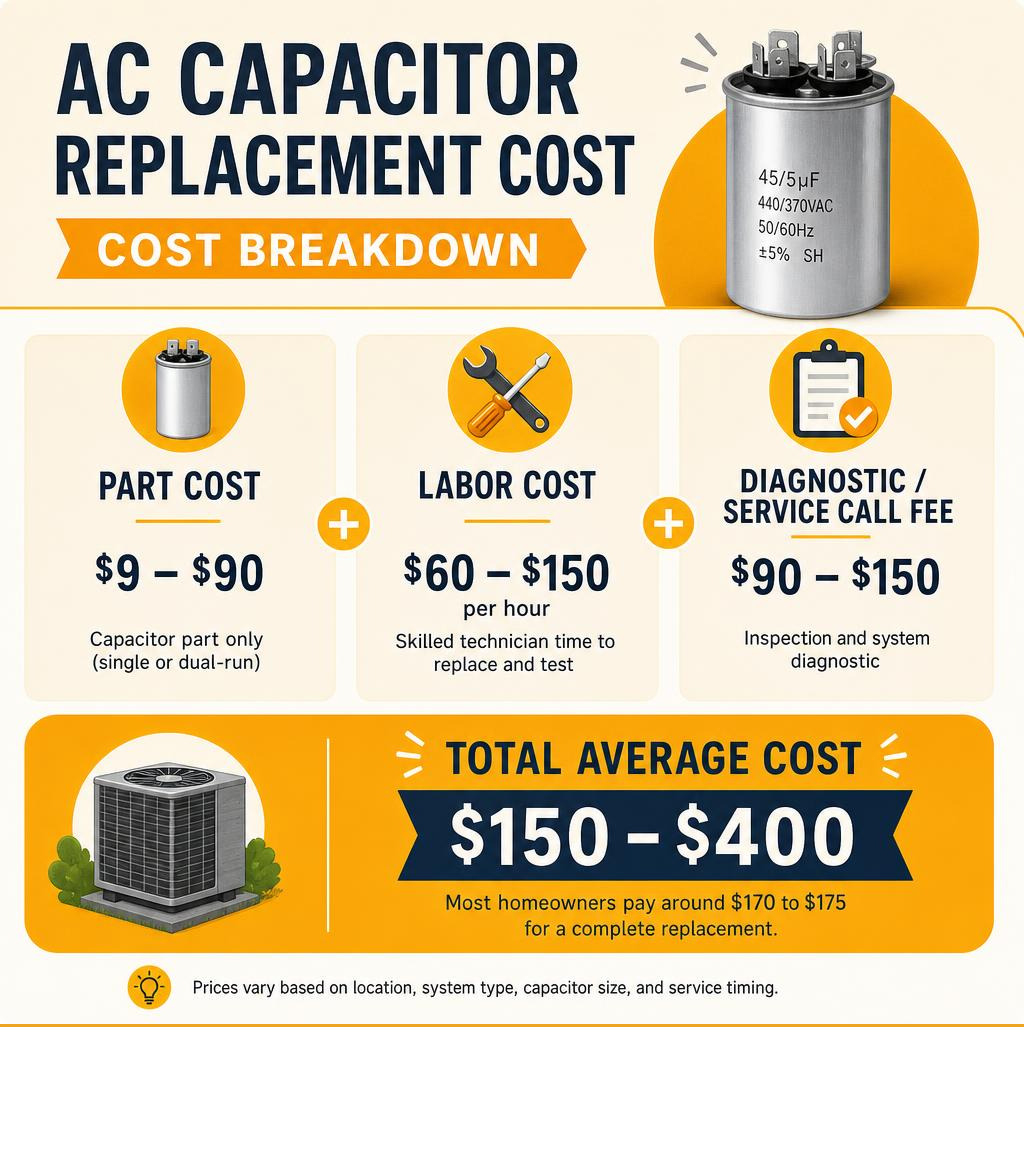
AC capacitor replacement cost typically falls between $150 and $400 for most homeowners, including parts and labor. Here is a quick breakdown of what to expect:
| Cost Component | Typical Range |
|---|---|
| Capacitor part only | $9 – $90 |
| Diagnostic / service call fee | $90 – $150 |
| Labor | $60 – $150 per hour |
| Total average cost | $150 – $400 |
A few key facts before you read further:
- Most homeowners pay around $170 to $175 for a complete replacement
- The part itself is inexpensive; labor and diagnostic fees make up most of the bill
- Dual-run capacitors cost more than single-run units
- Emergency or after-hours service can push costs to 1.5x to 2x the normal rate
- Replacing a failing capacitor early can prevent a far more expensive compressor repair
A bad capacitor is one of the most common reasons an air conditioner stops cooling, especially during peak summer heat. The part is small and cheap, but the total repair bill surprises many homeowners once labor and diagnostic fees are added in. Catching the problem early makes a real difference, both for your wallet and for the health of your entire cooling system.
I’m Chris Woods, owner of Woods Comfort Systems, a third-generation HVAC company serving Central Texas since 1956, and over the decades our team has handled countless AC capacitor replacement calls across San Marcos, TX, and the surrounding communities. I’ve put this guide together so you can walk into any service call informed, knowing exactly what you’re paying for and why.
What Is an AC Capacitor and What Does It Do?
To understand why this small part is so critical, think of an AC capacitor as a temporary battery for your cooling system. Your home electrical grid delivers a steady flow of electricity, but certain parts of your AC unit, specifically the compressor and the fan motors, require an immense surge of power to start spinning. Standard household wiring simply cannot deliver this massive initial electrical charge on its own.
This is where the capacitor steps in. It stores electrical energy from your home power supply and releases it in a powerful, concentrated burst when the thermostat calls for cooling. Once the motors are up and running, the capacitor continues to provide a steady, regulated current to keep them operating smoothly.
Capacitors are measured by two primary specifications:
- Microfarads (MFD or µF): This rating measures the electrical storage capacity of the unit. Standard residential AC capacitors typically range from 5 to 80 MFD.
- Voltage Rating: This indicates the maximum electrical pressure the capacitor can safely handle. Most residential systems use capacitors rated for 370V or 440V.
Choosing a replacement part with the exact matching microfarad rating is essential for system safety. If you would like to explore the technical specifications of these components further, you can read Bob Vila’s guide to AC capacitors for an in-depth breakdown of how they function within modern HVAC systems.
Start Capacitors vs. Run Capacitors
While all capacitors store energy, they serve different roles during the cooling cycle. Your outdoor air conditioning unit typically relies on two distinct types:
- Start Capacitors: These parts are designed to deliver a massive, brief burst of initial torque to get heavy motors moving from a complete standstill. They active for only a fraction of a second during startup and then cycle off.
- Run Capacitors: These components provide a continuous, steady electrical current to keep the compressor motor and condenser fan spinning efficiently throughout the entire cooling cycle.
In many modern residential systems, manufacturers use a dual-run capacitor. This is a single, cylindrical metal can that houses two capacitors in one. It features three terminals on top, labeled for the compressor, the fan, and the common power line. Dual-run units save space and simplify the wiring inside your system control panel, but because they perform two jobs at once, they tend to wear out faster under heavy summer workloads.
Common Signs of a Failing AC Capacitor
Because capacitors are electrical components, they do not always fail instantly. Often, they degrade slowly over several weeks or months, giving off warning signs before they quit completely. Recognizing these symptoms early can save you from a hot house and a much larger repair bill.
Here are the most common warning signs that your capacitor is on its way out:
- A Loud Humming Noise: If you walk outside and hear your outdoor unit humming loudly but the fan blades are not spinning, the run capacitor has likely failed. The motor is receiving power from the wall but lacks the starting torque to begin spinning.
- Clicking Sounds: You may hear a repetitive clicking sound coming from the outdoor control panel as the system tries and fails to engage the contactor and start the compressor.
- Warm Air from the Vents: If your indoor blower fan is running but the outdoor compressor cannot start, your system will circulate warm air throughout your home.
- Hard Starting: This occurs when your AC unit shudders, hesitates, or takes several seconds to kick on when a cooling cycle begins.
- Short Cycling: A weak capacitor may cause the compressor to shut down prematurely mid-cycle, leading to frequent on-and-off cycling that places immense strain on your equipment.
- A Bulging Top: If you look at the capacitor itself, the flat metal top should be perfectly level. If the top is swollen, domed, or bulging upward like a soda can left in a freezer, the internal safety seal has ruptured and the part must be replaced immediately.
If you notice any of these issues, it is best to act quickly. You can read more about identifying these electrical issues in our detailed guide on failing AC capacitor signs in San Marcos, TX. Ignoring these warnings can lead to system-wide failure, so it is also helpful to familiarize yourself with the broader signs your AC unit is close to a breakdown to protect your investment.
Understanding the AC Capacitor Replacement Cost
While the physical capacitor is one of the least expensive parts in an air conditioner, the total AC capacitor replacement cost is largely driven by professional labor, diagnostic expertise, and business overhead.
When you hire a licensed HVAC professional, your total bill is composed of several distinct charges:
- The Diagnostic Fee: Most reputable contractors charge a flat service call fee to send a technician to your home, diagnose the exact cause of the system failure, and verify that no other components were damaged.
- The Part Cost: The wholesale price of the capacitor varies depending on whether your system requires a basic single-run unit or a heavy-duty dual-run model.
- Labor and Safety Procedures: Replacing a capacitor involves working with high-voltage electricity. A trained technician must safely disconnect the power, discharge the stored electrical energy, verify system compatibility, install the new part, and test the overall electrical draw of the motors to ensure everything is operating within safe manufacturer specifications.
If you are planning your home maintenance budget, you can review Angi’s cost database to see how local service fees compare on a national scale. That scheduling repairs during normal business hours is always the most cost-effective option, as emergency, weekend, or after-hours service calls often incur premium labor rates.
Average AC Capacitor Replacement Cost by Component Type
The specific type of capacitor your system requires will directly influence your total repair bill. Different motors within your heating and cooling system rely on unique capacitors, each with distinct electrical ratings.
- Single-Run Capacitor: These basic parts support a single motor, such as the outdoor condenser fan motor. Because they only perform one job, they are inexpensive and quick to replace.
- Dual-Run Capacitor: Found in the majority of modern residential outdoor units, these components support both the compressor motor and the fan motor. They are highly common, but their complex internal design makes them slightly more expensive than single-run models.
- Start Capacitor: These heavy-duty units are built to deliver high torque and are often paired with a hard start kit to assist older or struggling compressors.
- Blower Motor Capacitor: Located inside your indoor air handler or furnace, this small capacitor ensures your indoor fan motor runs at the correct speed to circulate conditioned air.
- Heat Pump Capacitor: Systems that provide both heating and cooling use specialized capacitors designed to handle frequent reversing valve cycles and varied seasonal demands.
Addressing a failing capacitor promptly is the best way to protect your budget. If a weak capacitor is left in place, the compressor motor will overheat as it struggles to start. Over time, this intense heat melts the protective copper windings inside the pump, resulting in a catastrophic failure that requires a complete AC compressor replacement cost in San Marcos, TX, which can easily run into thousands of dollars.
How System Size and Location Affect Your AC Capacitor Replacement Cost
The physical size of your air conditioner, measured in tonnage, dictates the electrical demands of your compressor. Larger, high-capacity cooling systems require heavy-duty capacitors with higher microfarad ratings and voltage capacities, which carry a slightly higher parts cost.
Additionally, your geographic location plays a major role in local labor rates. Homeowners in hot, humid regions like San Marcos, TX, experience intense summer heat waves that place immense demand on local HVAC companies. During these peak summer months, scheduling a repair can be more challenging, and emergency service rates may apply if your system breaks down over a scorching weekend.
Finally, the physical accessibility of your equipment can impact labor times. If your outdoor unit is tucked into a tight crawlspace, mounted on a steep roof, or blocked by dense landscaping, the technician may require more time to safely access the control panel, which can increase the final labor charge.
Can You Replace an AC Capacitor Yourself?
In the age of online video tutorials, many homeowners are tempted to purchase a cheap capacitor online and attempt a DIY replacement. While the physical process of swapping the wires may look simple, DIY capacitor replacement is highly dangerous and is something we strongly advise against.
The primary danger is the massive amount of stored electrical energy inside the unit. Even if you turn off the main circuit breaker and pull the outdoor electrical disconnect, a healthy or partially damaged capacitor continues to hold a lethal electrical charge. Touching the copper terminals with your bare hands or an uninsulated tool can result in a severe, life-threatening electrical shock.
Safely discharging a capacitor requires specialized training, safety gear, and insulated tools designed to slowly bleed off the stored voltage. Furthermore, installing a capacitor with the incorrect microfarad or voltage rating can instantly burn out your outdoor fan motor or destroy your compressor, completely voiding your manufacturer warranty.
To keep your home and your family safe, it is always best to leave high-voltage electrical work to the professionals. You can read our guide on when to call an AC repair technician in San Marcos, TX, to understand the risks of DIY repairs and why professional diagnostics are essential for keeping your warranty intact.
How to Extend the Lifespan of Your AC Capacitor
While capacitors are considered consumable parts that will eventually wear out over time, there are several practical steps you can take to maximize their lifespan and avoid unexpected summer breakdowns:
- Keep the Condenser Coils Clean: When your outdoor coils are clogged with dirt, leaves, or grass clippings, the system cannot shed heat efficiently. This forces the compressor to run hotter and longer, which rapidly degrades the internal components of your capacitor.
- Provide Shade for Your Outdoor Unit: Intense, direct sunlight during hot Texas afternoons raises the internal temperature of your AC control panel. If possible, use landscaping or a small open structure to shade the unit, ensuring you maintain at least two feet of clearance for proper airflow.
- Install Surge Protection: Power surges from summer storms or utility grid fluctuations can instantly destroy a capacitor. Installing a dedicated HVAC surge protector protects your electrical components from sudden voltage spikes.
- Schedule Annual Maintenance: During a routine tune-up, a technician will use a multimeter to measure the exact microfarad output of your capacitor. If the reading has dropped more than 5% to 10% below its rated value, the technician can replace it on the spot, saving you from a system breakdown on the hottest day of the year.
Investing in regular upkeep is the most effective way to keep your system running smoothly. Joining one of our professional AC maintenance plans ensures your electrical components are tested twice a year, helping you catch weak parts early and maintain peak energy efficiency.
Frequently Asked Questions About AC Capacitor Replacement
How long does an AC capacitor typically last?
Most residential AC capacitors are designed to last between 5 and 15 years. However, their actual service life depends heavily on local operating conditions. In hot, humid climates where air conditioners run continuously for months at a time, capacitors face intense heat stress and typically need to be replaced every 5 to 8 years.
Is it safe to run an AC with a bad capacitor?
No, you should never run your air conditioner if you suspect the capacitor is failing. Operating the system with a weak or dead capacitor forces the fan motors and compressor to pull excessive electrical current directly from the wall. This leads to rapid overheating, tripped circuit breakers, and permanent motor damage.
Why do AC capacitors fail so often in hot weather?
Capacitors are filled with a liquid or gel dielectric material that helps store the electrical charge. Intense summer heat, combined with the high internal temperatures generated by continuous system operation, causes this dielectric material to degrade and break down over time. This breakdown reduces the capacitor’s ability to hold a charge, eventually causing it to fail.
Can a bad capacitor ruin an AC compressor?
Yes, a failing capacitor is one of the leading causes of compressor failure. When the capacitor cannot deliver the necessary starting power, the compressor will stall and overheat as it tries to start. If the system is left on, this heat will melt the internal motor windings, requiring an expensive compressor replacement or a completely new outdoor unit.
How long does it take a professional to replace a capacitor?
Once a licensed technician arrives at your home and diagnoses the issue, the physical replacement process typically takes between 30 and 45 minutes. This time includes safely turning off the power, discharging the old capacitor, installing the new part with correct wiring, restoring power, and testing the system to verify proper electrical draw.
What is the difference between a 370V and 440V capacitor?
These numbers represent the maximum voltage rating of the capacitor. A 440V capacitor is built to handle higher electrical pressure than a 370V unit. While you can safely use a 440V capacitor to replace a 370V unit because of the higher safety margin, you must never replace a 440V capacitor with a 370V unit, as doing so will cause the part to overheat and fail rapidly.
Does a failing capacitor increase energy bills?
Yes, as a capacitor degrades, the compressor and fan motors must draw more electrical current from your home grid to start and run. This increased power draw reduces the overall energy efficiency of your cooling system, leading to a noticeable spike in your monthly utility bills.
How do I know if my AC capacitor is bulging?
You can perform a quick visual inspection by looking through the top metal grate of your outdoor unit or opening the side control panel with the power disconnected. A healthy capacitor has a perfectly flat top. If the metal top is swollen, curved upward, or leaking a oily residue, the internal pressure relief valve has engaged, indicating the part has failed.
Should I repair or replace my AC if the capacitor fails?
Because a capacitor is an inexpensive part, replacing it is almost always the best choice, even on older systems. However, if your air conditioner is more than 10 to 15 years old, has a history of frequent breakdowns, and relies on outdated R-22 refrigerant, you may want to discuss whether a complete system upgrade is a better long-term investment.
What other parts should be checked when replacing a capacitor?
When a technician replaces a capacitor, they should also inspect the electrical contactor for pitted or burnt points, check the outdoor fan motor for bearing wear, and measure the operating refrigerant levels. Often, a failing capacitor is a symptom of an overworked motor or a dirty system that needs to be addressed to prevent future failures.
Conclusion
A failing AC capacitor does not have to ruin your summer comfort. While the AC capacitor replacement cost is highly manageable, catching the warning signs early and trusting the repair to a licensed professional is the best way to protect your home, your family, and your entire HVAC system from costly secondary damage.
For over 60 years, our family-owned team has kept homes across Central Texas cool and comfortable. Whether you need a quick electrical test, a routine summer tune-up, or emergency assistance on a hot weekend, we are here to provide the royal customer treatment you deserve.
If your air conditioner is humming, blowing warm air, or struggling to start up, do not wait for a complete system breakdown. Schedule professional AC repair with our experienced technicians, or contact our team at Woods Comfort Systems today to get your cooling system running safely and efficiently.