


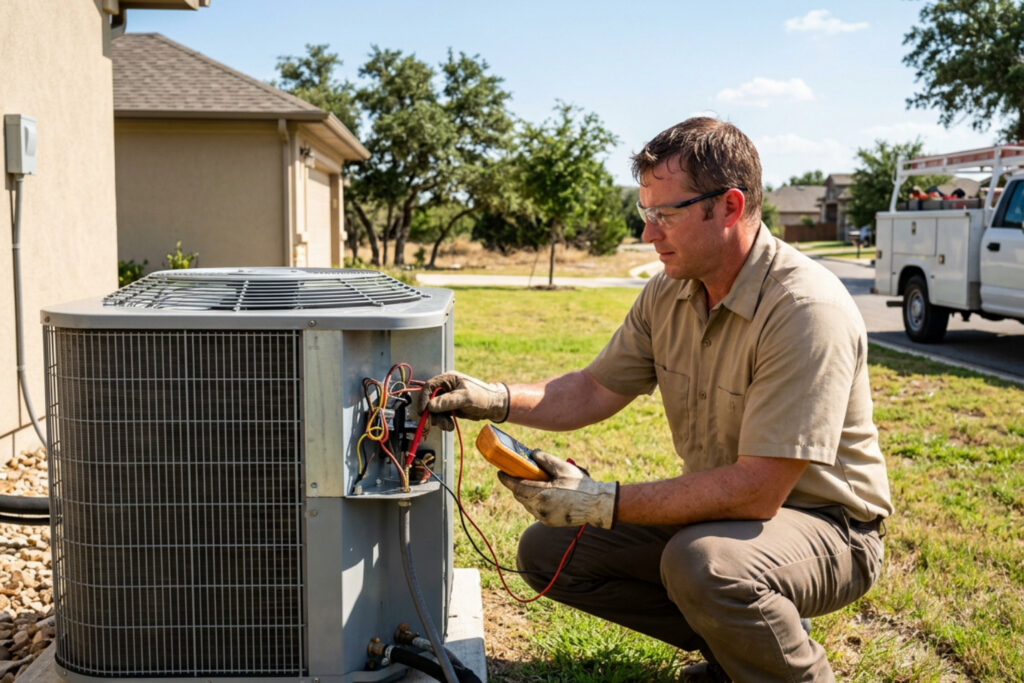
Is It Time to Repair or Replace Your AC? Here’s How to Decide
When it comes to AC repair vs replacement, most San Marcos, TX homeowners face the same dilemma: do you spend money fixing what you have, or invest in something new? Here is a quick answer to help you decide:
Repair your AC if:
- Your unit is under 10 years old
- The repair is minor and one-time
- Your system is still efficient and under warranty
- The repair cost multiplied by the unit’s age is under $5,000
Replace your AC if:
- Your unit is 12-15+ years old
- You are calling for repairs every year
- Your energy bills keep climbing
- The repair cost multiplied by the unit’s age exceeds $5,000
- Your system uses R-22 refrigerant (phased out in 2020)
In San Marcos, TX, summers are long, hot, and demanding on cooling equipment. The average AC system handles far more operating hours here than in cooler parts of the country. That means the repair-or-replace decision comes up sooner, and the stakes are higher.
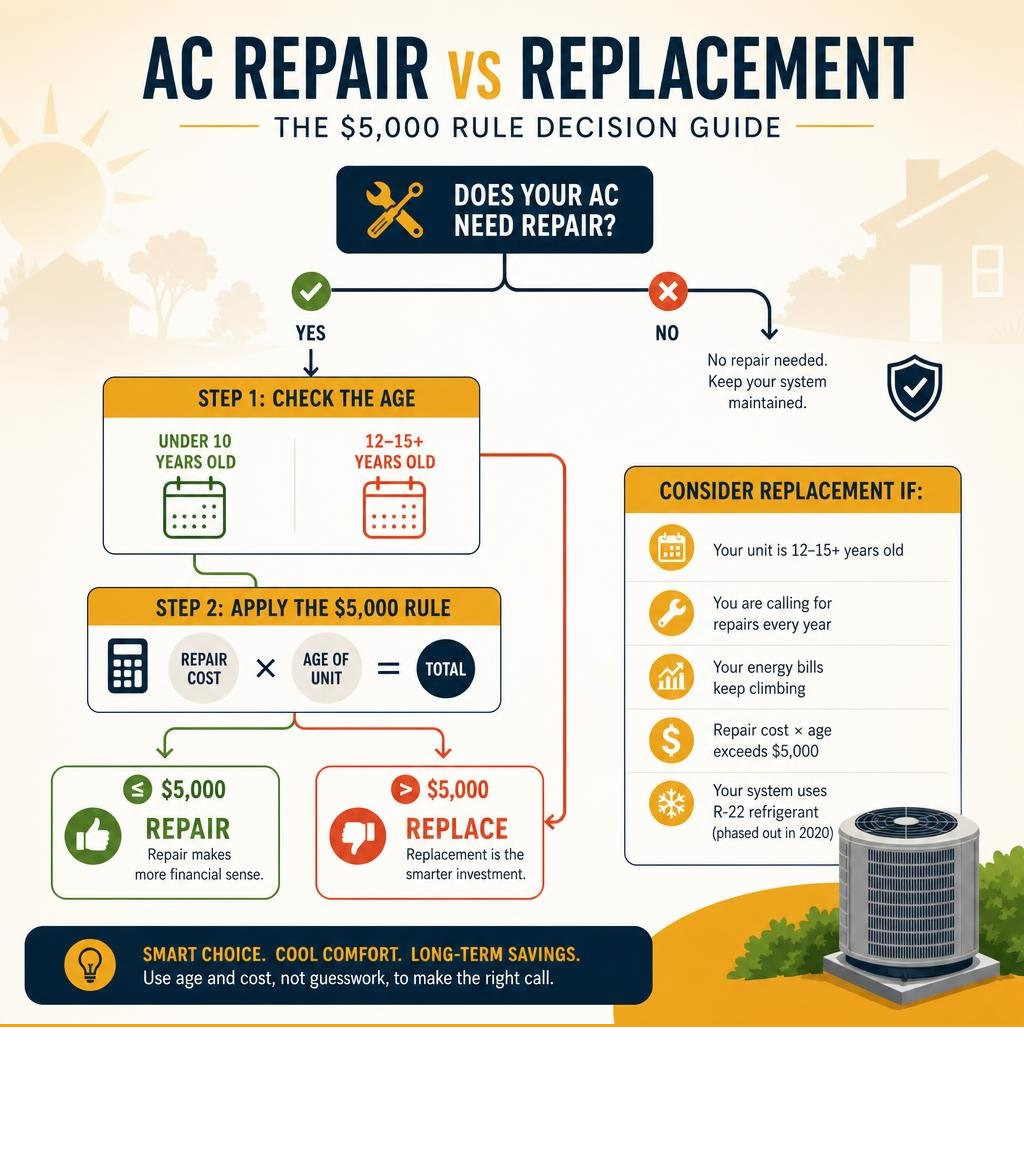
The good news is that there are clear, proven guidelines that take the guesswork out of this decision. The most widely used is the $5,000 rule: multiply your system’s age by the cost of the repair. If the result is over $5,000, replacement is likely the smarter move. If it is under $5,000, repair usually makes more financial sense.
I’m Chris Woods, owner of Woods Comfort Systems, a third-generation HVAC company serving Central TX since 1956. Over the decades, I have helped thousands of homeowners navigate the AC repair vs replacement decision, and I know how much the right choice can save you in the long run. In this guide, I will walk you through every factor you need to consider so you can make a confident, cost-effective decision for your San Marcos, TX home.
Deciding Between AC repair vs replacement: the $5,000 rule
When you are staring at an unexpected repair bill, it is easy to let stress dictate your next move. However, making a decision based on clear financial metrics will save you money and headaches over time. To take the emotion out of the process, we always recommend starting with a simple mathematical formula.
If you are trying to choose between when to repair or replace AC San Marcos, the $5,000 rule is the industry standard. This rule provides a reliable economic threshold that helps you evaluate whether putting money into an older system is a wise investment or a waste of capital.
To apply this rule, you simply multiply the age of your system in years by the estimated cost of the repair. If the total is less than $5,000, you should generally proceed with the repair. If the total is greater than $5,000, you should seriously consider a full system replacement.
Of course, this rule is a guideline rather than an absolute law. You must also consider how often your system is breaking down and how well it is keeping up with the brutal heat in San Marcos, TX. To get a complete picture, it helps to look at how long AC units last in San Marcos alongside your immediate repair estimates.
How System Age Impacts Your Decision
An air conditioner’s age is the single most important factor in the AC repair vs replacement debate. While a well-maintained cooling system can last anywhere from 10 to 20 years, the harsh Texas climate puts extra stress on local equipment. With extended summer runtimes and high humidity, most cooling systems in San Marcos, TX begin to show significant wear and tear after 12 to 15 years.
As a system ages, its internal components naturally degrade, causing it to run longer and consume more energy to achieve the same level of cooling. According to the federal Energy Star Guide on AC Replacement, if your heat pump or central air conditioning unit is more than 10 years old, it is highly beneficial to start planning for a replacement.
Older systems simply cannot match the efficiency of modern units, meaning you will continue to pay a premium on your monthly utility bills even if you keep repairing the old equipment.
Applying the $5,000 Rule to Your AC Unit
Let’s look at how the $5,000 rule works in real-world scenarios for homes in the San Marcos, TX area:
Scenario A (the newer system): You have a 6-year-old air conditioner that needs a new blower motor. The repair estimate is $600.
- The Math: 6 (years) x $600 (repair cost) = $3,600.
- The Decision: Since $3,600 is well below the $5,000 threshold, repairing the unit is the most cost-effective solution.
Scenario B (the older system): You have a 12-year-old air conditioner with a failed compressor. The repair estimate is $1,800.
- The Math: 12 (years) x $1,800 (repair cost) = $21,600.
- The Decision: Because $21,600 is vastly higher than the $5,000 threshold, investing in a replacement is the smarter long-term financial move.
By using this formula, you can easily see when a repair is a temporary band-aid on a failing system versus a smart way to extend the life of a reliable unit.
Key Indicators: when to repair your AC unit
Replacement is not always the answer. In fact, there are many situations where repairing your existing air conditioner is by far the better financial choice. If your system is relatively new and has been serviced regularly, a quick repair can restore peak performance without requiring a massive upfront investment.
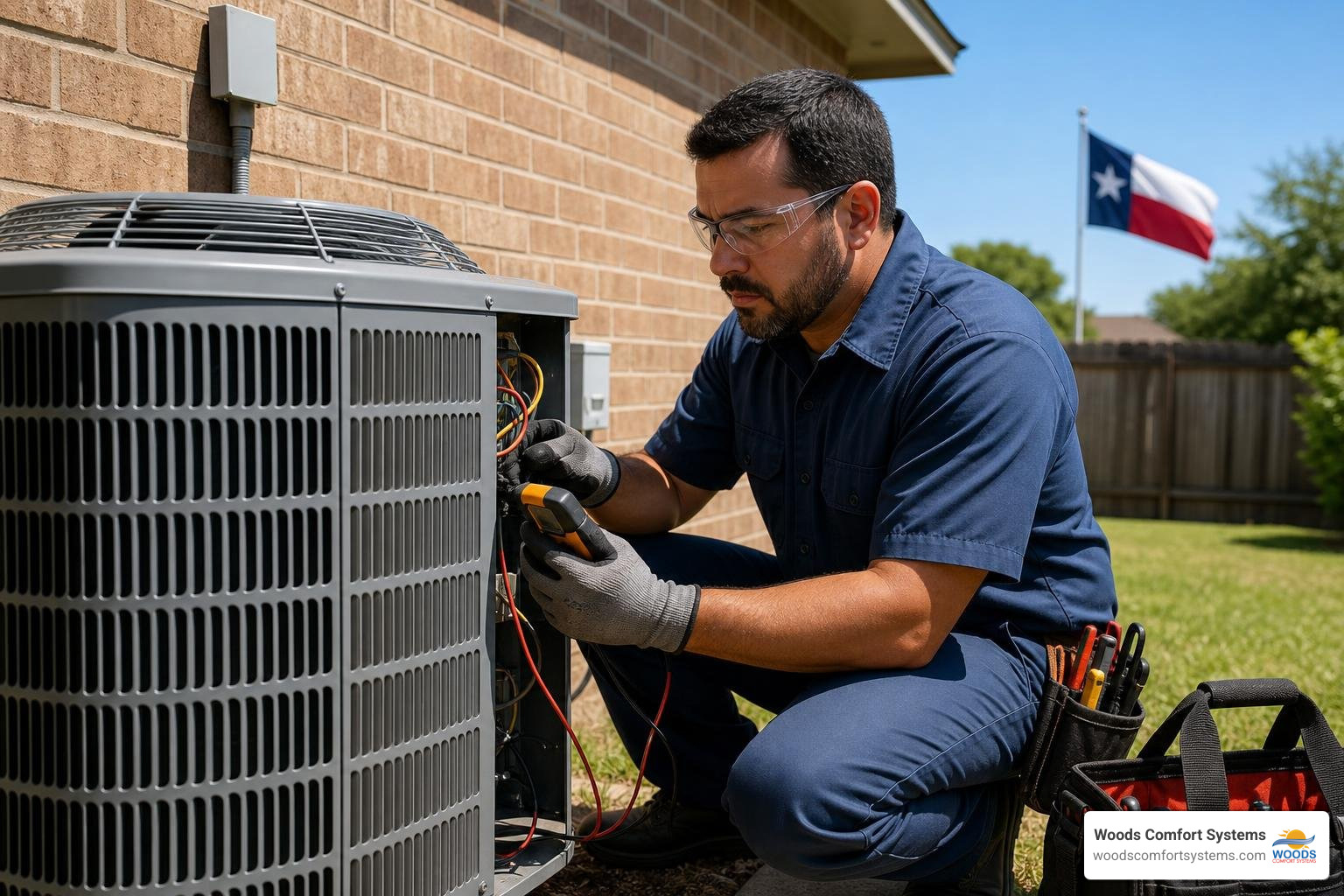
Evaluating the costs of AC repair vs replacement
Understanding the scale of your AC issue is crucial. Minor to moderate issues are almost always worth repairing, especially if the system is under 10 years old. These common repairs are straightforward and highly cost-effective:
- Capacitor replacement: Capacitors are responsible for starting and running the motors in your AC. They frequently fail due to summer heat, but replacing them is quick and inexpensive.
- Thermostat calibration or replacement: Sometimes, a system that won’t turn on or cool properly is simply suffering from a faulty thermostat, which is a simple fix.
- Condensate drain clearing: Algae and debris can clog your drain line, causing the system to shut down to prevent water damage. Clearing this line is a routine maintenance task.
When you compare these minor fixes to the overall AC installation cost in San Marcos, TX, repairing the unit is the obvious choice.
Signs your AC unit is still worth fixing
How do you know if your air conditioner has plenty of good years left? Your system is a prime candidate for a repair if it meets the following criteria:
- Consistent indoor comfort: Before this specific breakdown, your system had no trouble keeping your home cool and managing indoor humidity.
- Stable energy bills: Your monthly utility bills have remained consistent during the summer months, showing no sudden spikes in energy consumption.
- Active warranty coverage: If your system is still covered by a manufacturer parts warranty, the cost of the repair will be significantly lower, making it highly practical to fix.
- History of preventive maintenance: If we have performed annual tune-ups on your system, it likely has minimal internal wear and tear, meaning a single breakdown is just a minor bump in the road.
Key Indicators: when to replace your AC unit
While we always try to save our customers money with repairs, there comes a point where keeping an old system on life support becomes a financial burden. If you are experiencing frequent breakdowns or your home is no longer comfortable, it is time to look at a replacement.
To help you visualize the differences, here is a quick comparison table:
| Factor | Choose AC Repair | Choose AC Replacement |
|---|---|---|
| System Age | Under 10 years old | Over 12 to 15 years old |
| Refrigerant Type | R-410A or newer | Outdated R-22 (Freon) |
| Repair Frequency | Rare, one-off issues | Multiple service calls per year |
| Energy Bills | Consistent and predictable | Steadily rising month after month |
| Core Components | Compressor and coils are healthy | Failed compressor or leaking coils |
| Warranty Status | Covered under manufacturer warranty | Warranty has expired |
Long-term benefits of AC repair vs replacement
Investing in a new cooling system comes with immediate and long-term advantages that go far beyond simply having reliable cold air. Modern air conditioning systems are designed to meet strict federal efficiency standards, which translates directly into lower operating costs.
Upgrading to a high-efficiency system can lower your monthly energy bills by 20% to 40% compared to an older, standard model. By choosing a system with a high SEER2 (Seasonal Energy Efficiency Ratio) rating, you will enjoy:
- Substantial utility savings: Modern variable-speed compressors adjust their output to meet your exact cooling needs, consuming far less electricity.
- Enhanced indoor air quality: New systems feature advanced filtration and superior humidity control, keeping your home healthier and more comfortable.
- Quiet operation: Modern equipment runs much more quietly than older systems, reducing outdoor noise pollution.
To learn more about how these systems pay for themselves, explore the benefits of energy efficient AC system San Marcos, TX or read about selecting an energy efficient AC unit San Marcos, TX.
Environmental factors and refrigerant phase-outs
Environmental regulations have a massive impact on the cost of maintaining older air conditioners. If your system was installed before 2010, it likely relies on R-22 refrigerant, commonly known as Freon.
Because R-22 contributes to ozone depletion, the EPA phase-out of R-22 refrigerant banned its production and import in 2020. Today, the only available R-22 is reclaimed or recycled, making it incredibly scarce and expensive. If an older system develops a refrigerant leak, recharging it can cost thousands of dollars. Rather than investing in obsolete, environmentally harmful chemicals, we highly recommend upgrading to a modern system that uses eco-friendly refrigerants.
Recognizing the signs of systemic decline
When an air conditioner is nearing the end of its life, it will often give you several warning signs before it fails completely. Recognizing these signs of systemic decline can prevent you from being left without cooling during a scorching Texas heatwave.
Key warning signs include:
- Compressor failure: The compressor is the heart of your AC. If it fails on a system that is out of warranty, replacement is almost always the best option.
- Mismatched system components: If your indoor and outdoor units are not properly matched, your system will operate at extremely low efficiency and suffer from premature wear.
- Frequent cycling: If your AC turns on and off constantly without ever truly cooling your home, it is struggling to keep up.
If you notice these issues, check out our guide on signs replace air conditioner and review the signs AC unit close to breakdown to make sure you aren’t caught off guard.
Frequently Asked Questions about home cooling in Texas
Navigating HVAC decisions can be confusing. Here are answers to some of the most common questions we receive from homeowners in San Marcos, TX.
What is the $5,000 rule for AC units?
The $5,000 rule is a simple financial formula used to decide between repairing or replacing an air conditioner. You multiply the age of your system in years by the cost of the estimated repair. If the result is over $5,000, replacing the unit is generally the smarter financial choice. If it is under $5,000, repairing the system is usually recommended.
How long do AC units typically last in San Marcos, TX?
In San Marcos, TX, the combination of extreme summer heat and high humidity forces air conditioners to work much harder than in other parts of the country. Because of this heavy usage, a typical AC unit in our region lasts between 10 and 15 years. With regular professional maintenance, some high-quality models can last up to 20 years.
Is it worth repairing a 10 year old AC unit?
It depends on the nature of the repair. If the issue is minor, such as a bad capacitor or a clogged drain line, a repair is highly cost-effective. However, if the system has a major component failure, like a bad compressor, or if it uses outdated R-22 refrigerant, investing that money into a new, energy-efficient system is usually the wiser decision.
What are the signs that my AC unit is close to a breakdown?
Common warning signs of an impending breakdown include weak airflow, inconsistent temperatures throughout your home, frequent cycling on and off, unusual squealing or grinding noises, and sudden spikes in your monthly utility bills. If you notice any of these signs, it is best to have a professional technician inspect your system immediately.
Can replacing my AC unit lower my monthly energy bills?
Yes, absolutely. Modern air conditioning systems are significantly more efficient than those built a decade ago. Upgrading an old, inefficient unit to a new SEER2-certified model can reduce your monthly cooling costs by 20% to 40%, allowing the system to partially pay for itself over time.
Should I replace my furnace and AC unit at the same time?
In most cases, yes. Your furnace and AC share critical components, including the blower motor and ductwork. Replacing them together ensures that you have a perfectly matched system that operates at maximum efficiency. It also saves you money on labor costs, as our team can perform both installations during a single visit.
Why are repairs on older R-22 refrigerant systems so expensive?
R-22 refrigerant was phased out by environmental regulations due to its ozone-depleting properties, and its production was completely banned in 2020. Because the supply of R-22 is extremely limited, the cost of this refrigerant has skyrocketed, making any repair that requires a system recharge incredibly expensive.
What is the 50% rule for HVAC repair?
The 50% rule is another helpful financial guideline. It states that if the cost of a single repair estimate exceeds 50% of the cost of a brand-new system, you should replace the unit instead of repairing it. This prevents you from spending a large sum of money on a system that is still old and likely to break down again soon.
How does the Texas climate affect the lifespan of an AC system?
The intense heat in San Marcos, TX leads to extended runtimes and accelerated wear on electrical and mechanical components. This constant heavy workload shortens the average lifespan of local cooling systems compared to those in milder climates, making routine annual maintenance absolutely essential.
When is AC repair the better financial choice?
Repair is the better choice when your system is under 10 years old, has a history of reliable performance, and is facing a minor, one-off issue. It is also the ideal choice if your air conditioner is still covered by a manufacturer parts warranty, which keeps your out-of-pocket costs to a minimum.
Conclusion

Deciding between AC repair vs replacement does not have to be a stressful guessing game. By using practical tools like the $5,000 rule and assessing your system’s overall efficiency, you can make an informed choice that keeps your home comfortable and protects your hard-earned savings.
At Woods Comfort Systems, we have spent more than 60 years providing honest, reliable HVAC services to our neighbors in San Marcos, TX and across Central TX. As a family-owned business with deep roots in TX, we believe in treating every customer like royalty. Whether you need a quick fix in the middle of the night or a complete system upgrade, our team is available 24/7 to deliver the peace of mind you deserve.
Whether you need fast AC repairs, seasonal HVAC maintenance, or a complete system replacement, the team at Woods Comfort Systems is ready to help. If you are experiencing cooling issues, contact us today for professional AC repair services or schedule your professional HVAC service to get your home back to the perfect temperature.