


Is an HVAC Maintenance Plan vs Pay Per Visit Worth It for Your Home?
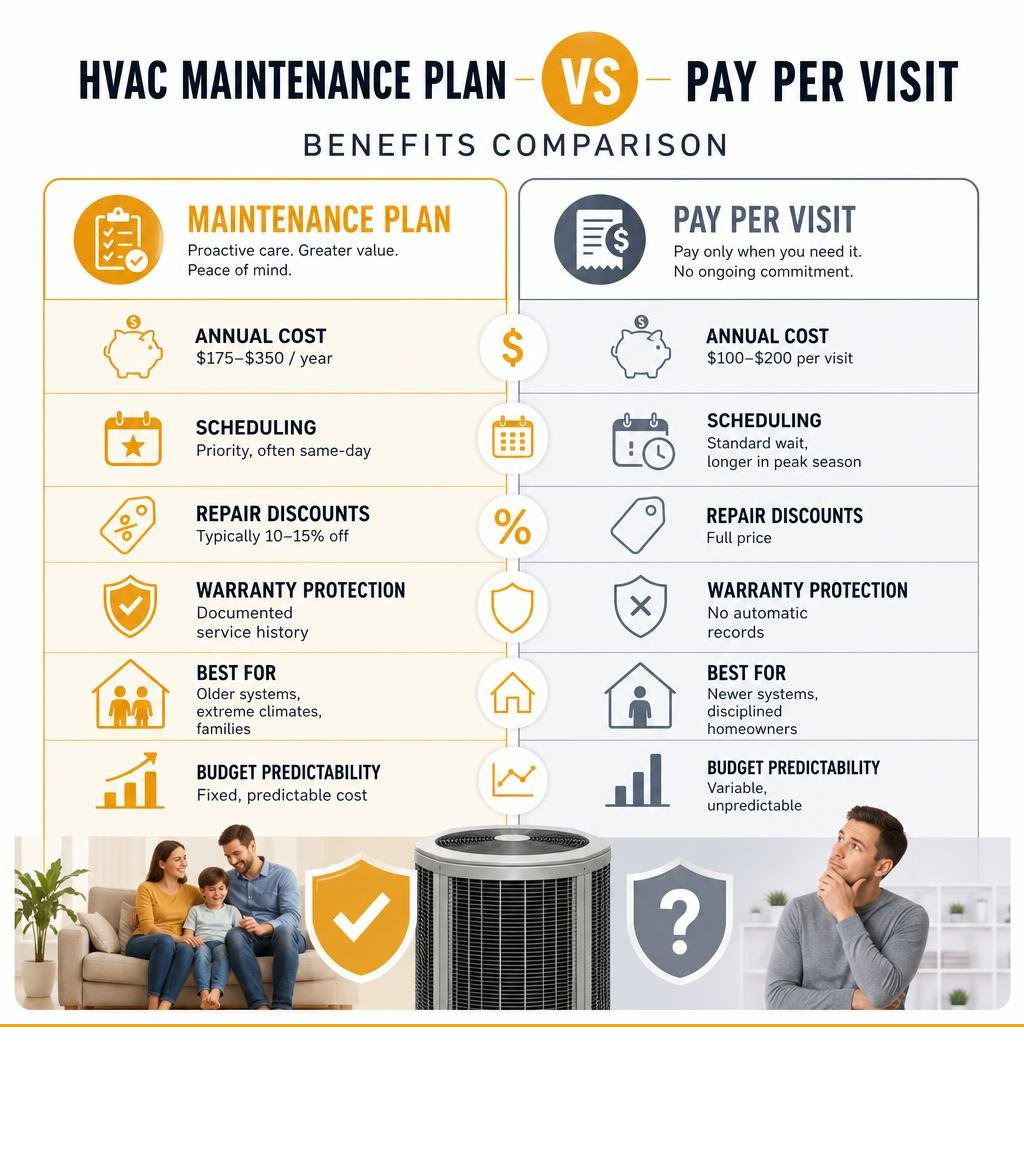
When weighing an HVAC maintenance plan vs pay per visit service, the right choice depends on your system’s age, your local climate, and how much predictability you want in your budget. Here is a quick breakdown to help you decide:
| Factor | Maintenance Plan | Pay Per Visit |
|---|---|---|
| Annual cost | Broad predictable yearly cost | Cost per individual visit |
| Scheduling | Priority, often faster | Standard wait, longer in peak season |
| Repair discounts | Often discounted | Full price |
| Warranty protection | Documented service history | Records depend on each visit |
| Best for | Older systems, extreme climates, families | Newer systems, disciplined homeowners |
| Budget predictability | Fixed, predictable cost | Variable, less predictable |
For most Central Texas homeowners running their AC hard through long, hot summers, a maintenance plan tends to deliver better long-term value. That said, pay-per-visit service can still make sense in specific situations, and we will walk through both.
At Woods Comfort Systems, our local team has served Central Texas homeowners since 1956. Over the decades, we have helped thousands of families think through the HVAC maintenance plan vs pay per visit decision, and our goal is to help you make the right call for your home and budget.
What is an HVAC Maintenance Plan and What Does It Include?
An HVAC maintenance plan is a pre-scheduled service agreement between you and a professional heating and cooling provider. Instead of waiting for your system to break down before calling a technician, you proactively schedule regular checkups. These agreements are designed to keep your heating and cooling equipment running at peak performance while preventing unexpected failures.
Most comprehensive plans include two primary service visits per year: one in the spring to prepare your AC for the grueling Texas summer, and one in the fall to ensure your heating system is ready for the winter chill. During these visits, a certified technician performs an intensive multi-point inspection and tune-up.
A standard professional tune-up checklist typically includes:
- Thermostat calibration: Ensuring your thermostat communicates accurately with your HVAC system to prevent unnecessary cycling and high energy bills.
- Electrical connection inspections: Tightening all electrical connections and measuring voltage and current on motors to prevent electrical hazards or component failure.
- Lubrication of moving parts: Reducing friction in the blower motor and other moving components, which minimizes wear and tear.
- Condensate drain line cleaning: Clearing out algae, dust, and debris from the drain line to prevent water backups that can cause severe water damage to your ceilings and walls.
- Coil cleaning and inspection: Cleaning the outdoor condenser coil and inspecting the indoor evaporator coil to optimize heat transfer and maintain system efficiency.
- Refrigerant level verification: Checking for proper refrigerant charges to ensure your system cools effectively without putting undue stress on the compressor.
- Safety control testing: Verifying that safety controls, ignition systems, and heat exchangers are functioning correctly to protect your home from gas leaks or carbon monoxide exposure.
For homeowners who want this work handled on a consistent schedule, Woods Comfort Systems offers HVAC maintenance plans that support routine heating and AC care across Central Texas. A plan helps keep service organized instead of leaving tune-ups to memory during busy seasons.
Professional maintenance is also helpful when your heating system needs seasonal attention. If you are preparing for cooler weather, our heating services team can inspect safety controls, airflow, ignition components, and other system details that require trained HVAC expertise.
Cost Comparison: Maintenance Plans vs. One-Off Visits
When analyzing the financial side of an HVAC maintenance plan vs pay per visit approach, it is important to look beyond the immediate receipt. You must consider both the predictable upfront commitment and the potential long-term expenses associated with system breakdowns.
Upfront Maintenance Costs
An annual HVAC maintenance plan usually creates a more predictable yearly expense because seasonal tune-ups are bundled into one service agreement. Many providers also offer monthly payment options, making it easier to plan for preventative care without waiting for a system problem.
Pay-per-visit service charges you for each individual appointment. If you schedule the recommended spring and fall visits on your own, the total may be similar to a plan in some years, but it depends on local service rates, timing, and whether additional diagnostic or trip fees apply.
Diagnostic Fees and Repair Savings
The real financial difference emerges when your system requires repairs. If you do not have a maintenance plan, a sudden system failure during a July heatwave in San Marcos, TX may include a diagnostic fee just to get a technician to your door. If the failure occurs after hours, on a weekend, or during a holiday, emergency or overtime fees may also apply.
For maintenance plan members, these diagnostic fees are often waived or discounted. Plan members may also receive discounts on parts and labor, depending on the agreement.
Consider a realistic scenario involving a failing capacitor:
- Pay-per-visit customer: Pays the diagnostic fee, the repair cost, and any applicable emergency fee if the system fails outside normal hours.
- Maintenance plan member: May receive a waived or discounted diagnostic fee, repair savings, and priority scheduling according to the plan terms.
By avoiding emergency fees and securing repair discounts, a maintenance plan member can save money on a single common repair. Over time, those savings can be more meaningful when the system is older, heavily used, or serving a household that cannot comfortably wait through long delays.
This is why many homeowners compare more than the price of one tune-up. Our article on the benefits of an HVAC maintenance plan explains how consistent service can support reliability, efficiency, and fewer surprise problems over the life of the system.
Evaluating an HVAC Maintenance Plan vs Pay Per Visit
Choosing between an HVAC maintenance plan vs pay per visit model requires evaluating your household’s unique needs, your system’s age, and your local climate.
In Central Texas communities like Wimberley, TX and New Braunfels, TX, cooling systems can run for much of the year. This intense operational demand accelerates wear and tear on electrical and mechanical parts.
To help you determine which model aligns with your goals, consider the following decision framework:
- System age: Older systems benefit from the close monitoring of a plan, while brand-new systems still need professional documentation to support manufacturer warranty requirements.
- Climate demands: If you live in an area with extreme summer temperatures, a maintenance plan may provide priority scheduling. When outdoor temperatures exceed 100 degrees, waiting days for a pay-per-visit technician is more than an inconvenience; it can be a safety concern for children, elderly family members, and pets.
- Budget predictability: If you prefer fixed, predictable monthly or annual expenses, a maintenance plan is usually the better fit. If you prefer to pay only when a specific service is performed and do not mind the risk of unexpected repair bills, pay-per-visit might suit your style.
- Peace of mind: Knowing that your system has been professionally inspected and cleared for the upcoming season reduces the anxiety of sudden summer breakdowns.
For homeowners in Kyle, TX and surrounding areas, our spring AC tune-up ROI article explains how pre-season maintenance can help reduce stress on cooling equipment before peak summer demand. That kind of proactive timing is especially useful in Central Texas, where AC systems often work hardest when appointment availability is tight.
When an HVAC Maintenance Plan vs Pay Per Visit Benefits Older Systems
As heating and cooling systems age, their components naturally degrade. Capacitors lose their charge, fan motor bearings wear down, and electrical contacts pit and corrode.
If you have an older system, a maintenance plan can be highly beneficial. During a routine inspection, a qualified technician can identify a tired capacitor or a failing contactor before it completely burns out. If left unaddressed, a minor component failure can cascade, causing the compressor to overheat and fail, which may lead to a major repair.
Regular professional maintenance can help extend the operational lifespan of your HVAC equipment by reducing strain, improving airflow, and catching developing issues earlier. For older systems, addressing these small issues early is the key to avoiding catastrophic breakdowns during peak seasons.
Choosing an HVAC Maintenance Plan vs Pay Per Visit for New Equipment
If your heating and cooling system was recently installed, you might assume that you do not need a maintenance plan. After all, everything is brand new and working properly.
However, enrolling in a maintenance plan for new equipment is primarily about warranty compliance and efficiency optimization. Many HVAC manufacturers require documented proof of regular, professional maintenance to keep parts warranties valid. If a critical component fails and you cannot produce records showing that the system was professionally serviced, the manufacturer may deny the warranty claim, leaving you responsible for the replacement part.
Additionally, keeping your new system clean and calibrated helps it operate at its intended efficiency level. This can support lower monthly utility bills from day one.
Key Questions to Ask Before Signing a Service Agreement
Before you sign any HVAC service agreement, it is vital to read the fine print and ask the right questions. Not all maintenance plans are created equal, and you want to ensure you are getting true value for your investment.
When evaluating a contract, ask the provider the following questions:
- What is included on the tune-up checklist? Ensure the plan covers comprehensive cleaning and safety checks, not just a basic visual inspection.
- Are there any exclusions? Some plans do not cover specific high-cost components like compressors, heat exchangers, or ductwork modifications. Know what is excluded before you sign.
- How does priority scheduling work during peak seasons? Ask if the provider gives members a defined service window during a summer heatwave.
- Are there emergency overtime fees for members? Find out if the plan waives or discounts diagnostic and overtime fees for after-hours, weekend, or holiday service calls.
- What is the cancellation policy? Ensure the plan allows you to cancel easily if you move or decide to switch providers, and ask if there are any hidden cancellation fees.
- Are your technicians certified? Verify that the technicians performing the work hold industry-standard certifications, such as NATE certification, to ensure your system is in expert hands.
Before choosing a plan, it helps to understand how ongoing service protects comfort, safety, and efficiency through the year. Our guide to heating maintenance plans in San Marcos, TX walks through practical reasons local homeowners use recurring maintenance instead of waiting for problems to appear.
Frequently Asked Questions
Is an HVAC maintenance plan worth the annual cost?
Yes. For most homeowners, the cost of an annual plan is offset by lower monthly utility bills, extended equipment lifespan, waived diagnostic fees, and discounts on repairs. It also provides peace of mind and priority scheduling during extreme weather.
What is typically included in a professional HVAC tune-up?
A professional tune-up includes cleaning the condenser and evaporator coils, clearing the condensate drain line, tightening electrical connections, lubricating moving parts, calibrating the thermostat, checking refrigerant charges, and testing all safety controls.
Can I perform preventative HVAC maintenance myself?
Homeowners should handle basic tasks like replacing air filters every one to three months, keeping return vents clear, and clearing debris from around the outdoor unit. However, technical tasks like electrical testing, refrigerant handling, and internal coil cleaning require specialized tools and certified professional expertise.
How does regular maintenance affect my manufacturer warranty?
Many manufacturers require documented proof of annual or biannual professional maintenance to keep your parts warranty valid. Neglecting regular professional service can void your warranty, leaving you responsible for the cost of major replacement parts.
How often should I schedule professional HVAC service in San Marcos, TX?
You should schedule professional service twice a year. We recommend scheduling an AC tune-up in the spring before the summer heat arrives, and a heating system checkup in the fall before winter temperatures drop.
Do maintenance plans cover emergency after-hours calls?
Many premium maintenance plans include waived or discounted diagnostic fees and priority dispatch for after-hours emergency calls, saving you from expensive overtime rates during peak season breakdowns.
Can I switch from pay-per-visit to a membership plan later?
Yes. Many homeowners start as pay-per-visit customers and transition to a maintenance plan, often signing up during a routine service call to immediately take advantage of member discounts and benefits.
Does a maintenance plan cover both heating and cooling systems?
Yes. Standard comprehensive maintenance plans are designed to cover both your cooling system in the spring and your heating system in the fall, ensuring year-round comfort and safety.
How does regular maintenance extend the lifespan of my HVAC system?
Regular maintenance reduces wear and tear on critical components, prevents small issues from cascading into major failures, keeps system lubrication fresh, and ensures clean airflow, allowing your system to run more smoothly for longer.
What happens if I need to cancel my HVAC service agreement?
Most reputable companies offer flexible cancellation policies. If you pay monthly, you can typically cancel at any time, though any balance due for services already rendered during that plan year may need to be settled.
Conclusion
Deciding between an HVAC maintenance plan vs pay per visit model comes down to how you prefer to manage your home comfort and budget. While pay-per-visit service offers flexibility for those with newer systems and the discipline to schedule their own appointments, a dedicated maintenance plan provides long-term savings potential, warranty protection, and critical priority scheduling when you need it most.
Whether you need seasonal HVAC maintenance, AC service, or help deciding which maintenance option fits your home, the team at Woods Comfort Systems is ready to help. Contact our professional HVAC maintenance technicians today and experience the royal treatment your home deserves.